
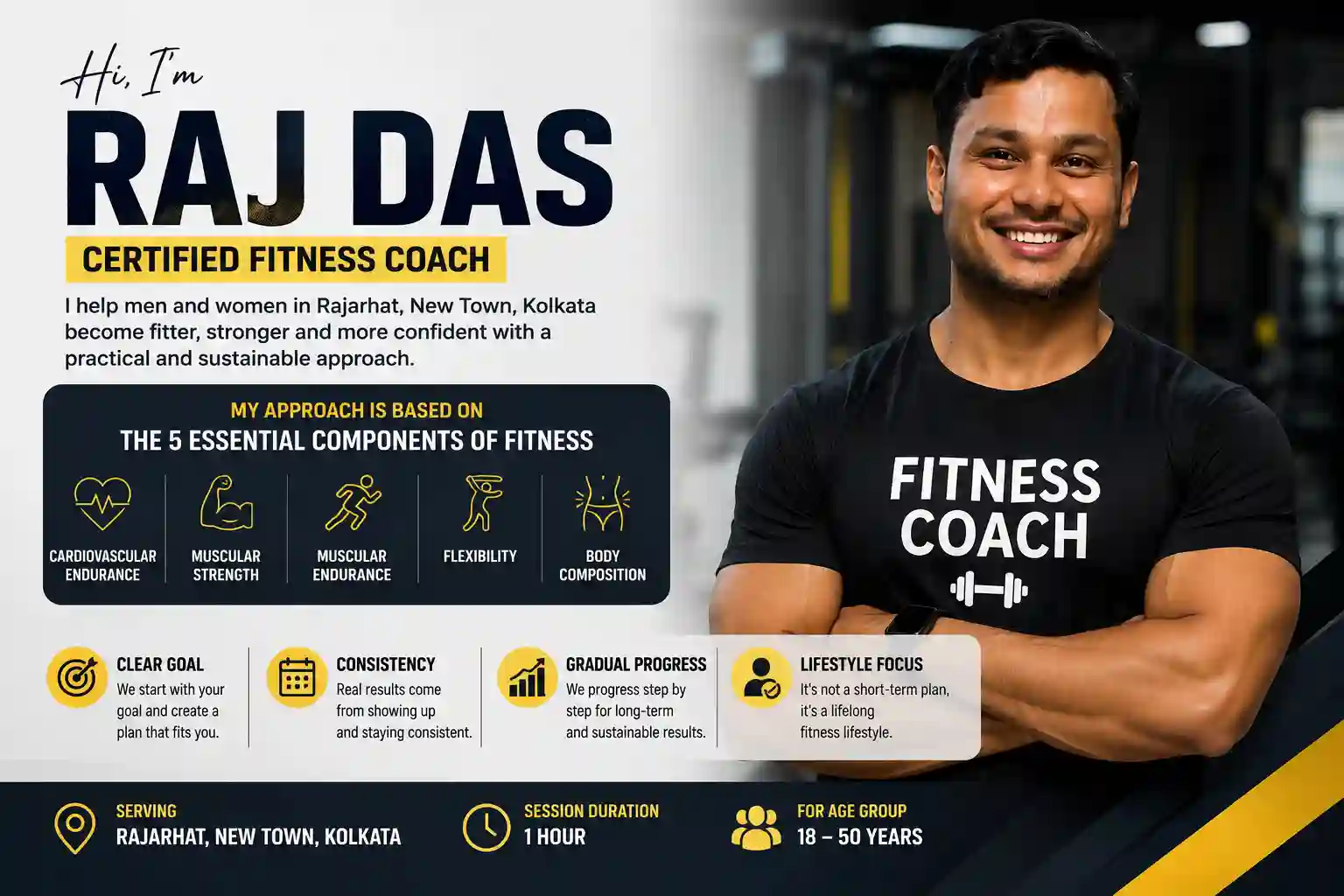
About Me: Raj Das, Personal Trainer in Rajarhat, New Town Kolkata
- Advanced Personal Trainer Pro (APT-Pro)
- NSQF Level-4 Certified Fitness Trainer (SPEFL-SC)
- Certified Trauma Responder (First Aid, CPR, & AED)
- Specialized in: Biomechanics, Applied Torque, Strength Systems, and Functional Training (Kettlebells & Agility)
My approach to fitness is practical. I don’t believe that transformation comes from following complicated plans for a few weeks and then returning to old habits. In my experience, the bigger challenge is building a fitness lifestyle that a person can actually continue.
That is why my coaching focuses on understanding where you are starting from, what you want to achieve, and what you can realistically maintain.
If you are serious about your transformation, yes, you can get results. My role is to help make that journey easier, more structured, and more practical.
I also specialize in weight-loss strategies by preserving muscle so that muscle can support your bone Health, helping you work toward sustainable fitness results through training, nutrition, and consistency.
Are you looking for 1-to-1 personal training or Group Fitness with all “5 fitness Components”? Then you are in the right place.
My Fitness Coaching Approach
I train beginners and general-fitness clients using the five essential components of fitness as the foundation of my approach:
- Cardiovascular endurance
- Muscular strength
- Muscular endurance
- Flexibility
- Body composition
I use exercises and training methods that I consider appropriate for general fitness and beginner development. If you have a specific fitness goal within my scope, I can adapt the training approach around that goal.
The objective isn’t simply to make every workout exhausting. A useful training session should have a purpose.
My standard sessions are Monthly 12 Session 1-hour each, giving us enough time to work through the planned training while keeping the process manageable.
What I Have Learned From Coaching
One of the most common problems I see is not necessarily a lack of information. People often already know that exercise, better eating habits, sleep, and consistency matter.
The real problem is consistency with the goal.
Someone may start with a lot of motivation, but motivation naturally changes. What matters more is creating habits and a routine that can continue when motivation is lower.
This is why I believe transformation begins with the mind as much as with the workout.
When we train the brain to accept fitness as part of everyday life, exercise becomes less of a temporary challenge and more of a lifestyle.
My Framework for Sustainable Fitness
1. Start With Your Real Goal
Before deciding what exercises to do, understand why you want to become fitter.
Your goal could be improving general fitness, becoming stronger, improving endurance, changing body composition, or simply becoming more active.
A clear goal gives training direction.
2. Build the Five Fitness Components
I don’t want beginners to focus on only one aspect of fitness.
A practical general-fitness programme should develop cardiovascular fitness, strength, muscular endurance, flexibility, and body composition together, according to the person’s needs and starting point.
3. Make Consistency the Priority
A perfect workout plan that you cannot follow is less useful than a realistic plan you can consistently maintain.
My coaching focuses on helping clients develop a routine they can actually follow.
4. Progress Gradually
Fitness is not something that needs to be rushed.
Training should progress according to your current ability, experience, recovery, and goal. The objective is to create sustainable improvement rather than chase short-term results at any cost.
How I Approach Weight Loss
For weight loss, my approach is centred on body composition and sustainable progress, rather than promising a quick transformation.
I want clients to understand that the scale is only one measurement. Fitness involves more than body weight.
Building healthier habits, becoming more active, improving fitness, and developing a sustainable routine can all form part of a long-term transformation.
I also believe that a person’s lifestyle matters. If fitness becomes something you can maintain rather than something you temporarily force yourself to do, the chances of continuing are much better.
Who I Currently Train
At present, my general-fitness coaching is intended for men and women aged 18–50, an apparently healthy general population, who want support with general fitness or goals that fall within my current training scope.
I especially welcome beginners who don’t know where to start or feel overwhelmed by conflicting fitness advice.
I currently work with clients in and around Rajarhat and New Town, Kolkata, where I can provide practical coaching based on their fitness goals and current level.
| Client Group | Training Focus |
|---|---|
| General Fitness Seekers | General physical preparedness, muscle toning, strength building, and endurance improvement. |
| Weight Management Clients | Fat loss, muscle hypertrophy (growth), and body composition changes. |
| Cardio & Agility Trainees | Customized cardio strategies, HIIT, and functional equipment training such as battle ropes and kettlebells, where covered in the specific module. |
Who I Don’t Currently Train
I want to be transparent about my professional boundaries.
At this stage, I do not provide specialised training for special populations. This includes people who may have unique physical, medical, or physiological needs requiring specialised programming, closer supervision, or medical clearance.
This can include older adults, pregnant individuals, and people living with chronic health conditions or disabilities.
I would rather be honest about my current qualifications than provide training outside my area of competence.
| Special Population | Limitation / Requirement |
|---|---|
| Severe Medical Conditions | Standard Personal Training does not fully specialize trainers to work with clients with severe medical conditions. |
| Metabolic Disorders | Requires additional specialized knowledge and training beyond the standard Personal Training. |
| Major Orthopedic Injuries | Conditions such as active arthritis and rehabilitation after a fracture are outside the standard Personal Training scope. |
| Cardiovascular Pathologies | Requires specialized training beyond the standard General Personal Training. |
| Recommended Certification | Separate Personal Training for Special Populations (PT-SP) certification for safely and appropriately training specific medical or special-needs groups. |
Note: I plan to begin Special Populations training in March 2027, after completing the relevant education.
Why Choose Me as Your Fitness Coach?
If you’re looking for a coach who will simply give you exercises and leave you to figure everything else out, I may not be the right choice.
My goal is different.
I want to use what I have learned through my experience in fitness coaching to make the process practical for you. I’ll help you understand what you’re doing, why you’re doing it, and how consistency can move you towards your goal.
You don’t need to be an experienced gym-goer to start.
You need a realistic goal, willingness to learn, and commitment to the process.
A Practical Start to Your Fitness Journey
If you live in Rajarhat or New Town, Kolkata, and you’re an adult between 18 and 50 looking for general fitness coaching, you can start by discussing your current fitness level, goal, experience, and expectations with me.
I’ll be straightforward about what I can help with and where my professional boundaries are.
For me, fitness coaching isn’t about promising everyone the same result. It’s about helping the right person follow the right process consistently.
I’m Raj Das, Certified Fitness Coach, and I’m here to help you make fitness a sustainable part of your life.
Your Program Starts With Your Goals—not a Generic Workout
A good fitness program should answer one fundamental question: Why are you training?
Your program may prioritize hypertrophy, maximal strength, fat loss, muscular endurance, cardiovascular fitness, athletic performance, mobility, or a combination of these objectives.
From there, training variables can be organized around your needs, including:
-
Exercise selection
-
Training frequency
-
Sets and repetitions
-
Resistance and intensity
-
Rest periods
-
Movement patterns
-
Cardio volume and intensity
-
Recovery requirements
-
Progressive overload
Build strength and muscle with intelligent resistance training
Muscle growth is not simply about lifting heavier weights every session. Effective resistance training requires appropriate mechanical tension, sufficient training volume, recovery, and progressive overload.
Your program can incorporate foundational movements such as squats, hinges, pushes, pulls, carries, and targeted accessory exercises while accounting for individual mobility, leverage, experience, and tolerance.
Advanced techniques—including supersets, drop sets, and pyramid-style training—can be introduced when they serve a specific purpose rather than being added simply to make workouts harder.
Lose fat without turning fitness into punishment
Fat loss requires an appropriate energy deficit over time, but that does not mean endless cardio or extremely restrictive eating.
A practical fat-loss strategy can combine resistance training to support lean tissue, appropriately dosed cardiovascular exercise, sustainable nutrition habits, adequate protein, sleep, and recovery.
The goal is to create a plan you can actually follow—not one that produces short-term results at the expense of your energy, performance, or adherence.
Improve exercise technique through movement assessment
A movement-focused approach can look at posture, joint positioning, stability, mobility, coordination, and common movement patterns.
Rather than assuming that everyone should perform an exercise identically, coaching considers your individual structure and movement capabilities.
This can help you learn how to:
-
Establish effective positioning
-
Control range of motion
-
Improve stability and coordination
-
Use appropriate resistance
-
Recognize technique breakdown
-
Select exercise variations that fit your current ability
Better technique does not mean making every movement look identical. It means finding a controlled, appropriate way to perform the exercise for your body and your training objective.
Understand How Your Body Produces Energy
Your body uses multiple energy systems during exercise, with their contribution changing according to intensity and duration.
ATP-PC system
The phosphagen or ATP-PC system contributes heavily to very short, high-intensity efforts such as explosive movements and heavy strength work.
Glycolytic system
The glycolytic system becomes increasingly important during demanding efforts lasting longer than a few seconds, particularly when exercise intensity remains high.
Oxidative system
The oxidative system plays a major role during longer-duration activity and also contributes continuously to energy production, including during recovery between harder efforts.
Understanding these systems helps determine how to structure strength training, conditioning, work intervals, rest periods, and cardiovascular exercise instead of treating all cardio or all high-intensity training as interchangeable.
Progressive Overload: The Engine Behind Long-Term Progress
Doing the same workout repeatedly may maintain your current abilities, but meaningful improvement generally requires an appropriate training stimulus that develops over time.
Progressive overload can involve more than simply adding weight.
Your progression may include
-
Increasing resistance
-
Performing additional quality repetitions
-
Adding productive training volume
-
Improving exercise technique
-
Increasing range of motion when appropriate
-
Reducing unnecessary rest
-
Improving work capacity
-
Progressing to a more challenging exercise variation
The right progression depends on the goal. Strength development, hypertrophy, endurance, and general fitness do not all require identical progression models.
Nutrition Guidance That Supports Your Training
Training and nutrition work together.
For body-composition goals, calorie intake, protein, carbohydrates, fats, meal structure, hydration, and food quality all deserve consideration.
Create a nutrition strategy you can maintain
Rather than relying on extreme diets, a practical approach can establish appropriate calorie targets and macronutrient priorities based on your goal.
For fat loss, this may involve a sustainable calorie deficit. For muscle or performance goals, it may involve maintaining energy availability or using a controlled calorie surplus.
Nutrition recommendations should also consider food preferences, schedule, training demands, and adherence.
What about supplements?
Supplements can be useful in specific circumstances, but they should complement—not replace—a strong foundation of nutrition, training, sleep, and recovery.
Evidence, safety, individual circumstances, and applicable regulations should be considered before using sports supplements.
Recovery Is Part of the Program
Progress does not happen only while you are training.
Your body needs adequate recovery to adapt to training stress. Recovery planning can include sleep, rest days, appropriate training volume, mobility work, flexibility exercises, hydration, and sensible workload management.
Warm up with purpose
Dynamic warm-ups can prepare you for the movements and intensities you are about to perform. The warm-up should complement the session rather than unnecessarily exhausting you before your working sets.
Use mobility and flexibility strategically
Mobility and flexibility work can be included according to your needs and training objectives. Static stretching, dynamic mobility, and foam rolling may each have a place within a broader recovery strategy, depending on timing and purpose.
Stop Guessing. Start Training With a Plan.
You do not need to spend another month jumping between random workouts, conflicting fitness advice, and unrealistic diet plans.
You need a strategy that connects your goal to your training, your training to your recovery, and your progress to the next appropriate step.
With evidence-based fitness coaching, every part of the process has a reason—from exercise selection and technique to progressive overload, conditioning, nutrition, and recovery.
Ready to make your training more effective?
If you are serious about building strength, improving your physique, losing fat, increasing fitness, or becoming more capable in everyday movement, let’s build a program around you—not around a generic template.
Start with your goal, assess where you are now, and create the next step toward measurable progress. Contact Me
