
A practical weight-loss framework for busy people in New Town, Rajarhat and Kolkata
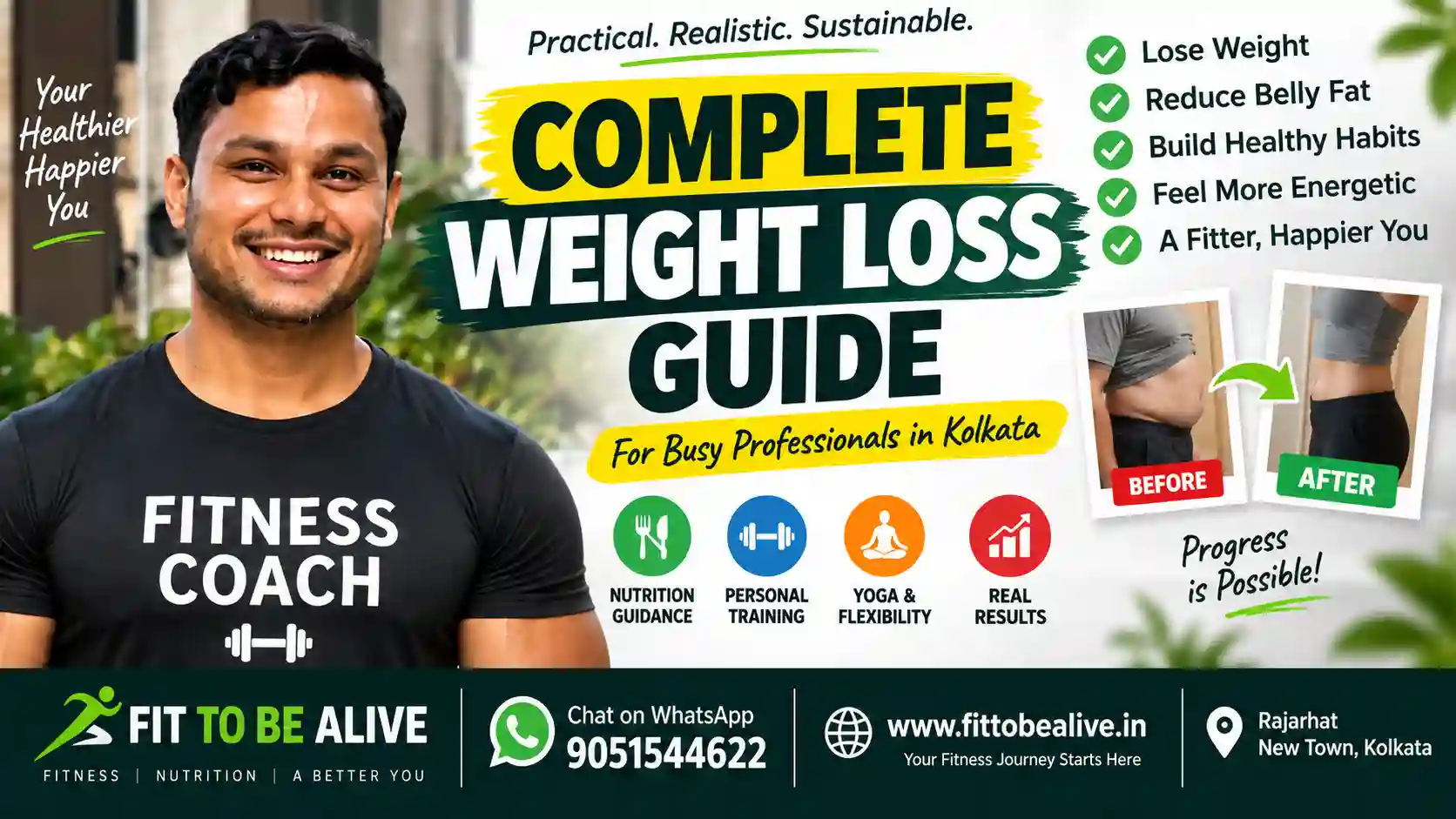
Quick answer: The most practical approach to weight loss is not an extreme diet or an exhausting workout routine. It is a structured combination of sensible nutrition, resistance training, cardiovascular activity, daily movement, recovery and consistency. For busy professionals, the best plan is one that fits around work and can be followed for months—not just for seven or ten days.
If you live or work around New Town, Rajarhat or Kolkata, this guide gives you a practical framework for getting started with fat loss while working on overall body composition and fitness.
I’m Raj Das, Certified Advanced Personal Trainer, and my approach is based on practical coaching experience, exercise science and the idea that fitness should become part of your lifestyle.
Why weight loss becomes difficult for busy professionals
In my experience, many people already know the basics.
They know they should exercise.
They know they should eat better.
They know sleep matters.
The problem is usually consistency with the goal.
A demanding job, commuting, meetings, family responsibilities, social occasions and irregular meals can make even a good plan difficult to follow.
That is why I don’t believe your weight-loss programme should depend on motivation alone.
Instead, we build a system.
Your system should answer five questions:
What is your goal?
What should you eat most of the time?
What type of training should you do?
How will you manage your busy schedule?
How will you measure progress?
This is the foundation of a realistic weight loss plan.
What is the best way to lose weight fast?
If by “fast” you mean losing weight as quickly as possible, I would not recommend chasing an aggressive deadline.
A better question is: What is the fastest rate of progress that you can maintain safely and consistently?
Weight loss happens when your overall energy intake is lower than your energy expenditure over time. But the quality of the plan matters too.
A sustainable approach can combine:
A manageable calorie deficit
Nutrient-dense foods
Adequate protein
Strength training
Cardiovascular activity
Regular daily movement
Adequate sleep
Stress management
Consistent monitoring
Gradual weight loss is generally easier to maintain than trying to force dramatic changes in a very short period.
So, instead of asking how to lose a large amount of weight in a few days, ask:
“What can I realistically repeat next week, next month and six months from now?”
That question changes the entire approach.
My body-composition approach to weight loss
I don’t want clients to focus only on the number shown on the weighing scale.
My approach to weight loss is centred around body composition and sustainable progress.
Body weight is one measurement. Your strength, fitness, waist measurement, physical performance, habits and overall consistency can also tell you whether your programme is moving in the right direction.
For many people, the objective is not simply to become lighter.
It is to become fitter, stronger and healthier while reducing excess body fat.
This is where resistance training becomes particularly useful within a complete fitness programme.
How to lose belly fat safely
One of the most common questions I hear is:
“How can I lose belly fat?”
The important thing to understand is that you cannot reliably choose exactly where your body loses fat first.
Doing hundreds of abdominal exercises does not mean that the fat around your stomach will automatically disappear.
Instead, work on the bigger picture:
Create an appropriate calorie deficit through your overall diet and activity.
Perform resistance training.
Include cardiovascular exercise.
Increase everyday movement.
Eat a balanced diet.
Sleep adequately.
Stay consistent.
You can strengthen your abdominal muscles with exercises such as controlled core training, but reducing overall body fat requires a broader strategy.
So if you are searching for how to lose belly fat safely, don’t look for a single “belly-fat exercise”.
Build a complete programme.
A beginner weight loss meal plan should be simple
You do not need complicated recipes or a completely different diet from your family.
A practical beginner weight loss meal plan can be built around foods you already understand and enjoy.
For example, a simple day might look like:
Breakfast:
Eggs or another protein source with vegetables and a suitable carbohydrate source such as oats, roti or another whole-grain option.
Lunch:
Rice or roti, dal or another protein source, vegetables and an appropriate portion of fish, chicken, eggs, paneer or another protein-rich food.
Snack:
Fruit, curd/yogurt, or another convenient whole-food option.
Dinner:
A protein source, plenty of vegetables and a suitable portion of rice, roti or another carbohydrate depending on your needs.
This is only a framework, not a personalised prescription.
Your actual nutritional requirements depend on factors such as your body size, activity level, training, food preferences and individual circumstances.
The key is to make your everyday food pattern easier to maintain rather than trying to survive on an extremely restrictive diet.
Sustainable weight loss tips for working professionals
Here are some of the practical habits I encourage:
1. Plan your training before the week starts
If exercise is something you “will do when you get time”, it can easily disappear from your schedule.
Choose your training days in advance.
2. Keep convenient food available
When you’re extremely hungry after work, convenience often wins.
Keep practical options available at home and work so that every meal does not become an emergency decision.
3. Don’t make one imperfect meal into an imperfect week
You may have a restaurant meal, Bengali sweets, biryani or a social dinner.
That doesn’t mean the entire plan has failed.
Return to your normal routine at the next meal.
4. Focus on consistency before complexity
A simple training programme performed consistently can be more useful than a complicated programme that you abandon after two weeks.
5. Track something meaningful
You can monitor body weight, waist measurement, training performance, activity, food habits or other agreed indicators.
The purpose is not to become obsessed with numbers.
The purpose is to understand whether your habits are moving in the right direction.
The five fitness components I use
My training approach covers the five essential components of fitness:
Cardiovascular endurance
Muscular strength
Muscular endurance
Flexibility
Body composition
For beginners, I don’t want training to become only about burning calories.
We can work on movement quality, strength, endurance, mobility and body composition together according to the person’s goal and current fitness level.
Exercises I commonly use for general fitness can include walking or other cardiovascular activities, resistance exercises, fundamental movement patterns, mobility work, flexibility exercises and functional training.
The exact exercises, volume and progression should depend on the individual.
A simple weekly framework
For a busy professional, the programme doesn’t have to be unnecessarily complicated.
A week might include:
2–3 resistance-training sessions
Focus on major movement patterns and progressive improvement.
Regular cardiovascular activity
Walking, cycling or another activity that suits your fitness level and schedule.
Daily movement
Look for opportunities to walk, take movement breaks and avoid spending the entire day sitting.
Mobility and flexibility work
Use appropriate exercises to support movement quality and your individual needs.
Recovery
Give your body adequate rest and pay attention to sleep.
Current public-health guidance commonly recommends adults accumulate at least 150 minutes of moderate-intensity aerobic activity per week and perform muscle-strengthening activities on at least two days per week, although individual needs vary.
The important point is not to treat these numbers as a competition.
Start from your current ability and progress appropriately.
What I have learned from coaching beginners
One of the biggest mistakes I see is inconsistency.
Someone starts Monday with complete motivation.
By the second or third week, work becomes busy.
Then the diet changes.
Then training stops.
Then the person feels guilty and decides to restart next Monday.
This cycle can continue for months.
My approach is different.
I want you to develop a fitness lifestyle.
Transformation becomes much easier when your brain starts accepting exercise and healthy habits as normal parts of your life.
You don’t need to be perfect.
You need a process you can return to.
Meet Your Coach: Raj Das
I’m Raj Das – Certified Advanced Personal Trainer, with more than 2 years of experience in the fitness industry.
My core knowledge and understanding include:
Human anatomy
Exercise science
Physiology
Kinesiology
Biomechanics
Nutrition
Posture correction
Functional training
My guidance includes weight training for strength, nutrition guidance, and yoga-based mobility and flexibility work.
My areas of coaching include:
Weight loss
Fat loss
Muscle building and hypertrophy
Body recomposition
Strength
Nutrition
Postural correction
Mobility and flexibility
Functional training
My training method uses the five essential components of fitness: cardiovascular endurance, muscular strength, muscular endurance, flexibility and body composition.
If you are serious about your transformation, my answer to the question “Will I get results?” is simple:
Yes, you can make meaningful progress when you are serious about the process, consistent with the plan and working within an appropriate programme.
My role is to make that journey easier, more structured and more practical.
Who I currently train
My current coaching scope is general fitness for adults aged 18–55, including beginners, men and women, provided the person is appropriate for general-fitness training.
I can help beginners learn exercise fundamentals and build a structured fitness routine.
If you have a specific goal that falls within my current scope, I can adapt the training around that goal.
My local service area is Rajarhat, New Town, Kolkata.
An important professional boundary
I currently do not provide specialised training for special populations.
This includes people with unique physical, medical or physiological needs who may require specialised programming, closer supervision or medical clearance.
Examples can include:
Older adults requiring specialised programming
Pregnant individuals
People with chronic health conditions
People with disabilities
Certain medical or rehabilitation situations
I believe being transparent about professional boundaries is important.
I do not want to provide specialised training without having the appropriate education and preparation.
I plan to begin Special Populations training and Nutrition education in March 2027, after completing the relevant education.
If you have a medical condition, injury, disability, pregnancy or another situation requiring specialised care, speak with an appropriately qualified healthcare professional before beginning exercise.
Your practical weight-loss framework
If you are starting from zero, don’t try to change everything in one week.
Start with this framework:
Step 1 — Define the goal
Decide whether your primary objective is fat loss, body composition, strength, fitness or another measurable goal.
Step 2 — Assess your current routine
Look honestly at your meals, activity, training, sleep and schedule.
Step 3 — Create a manageable calorie deficit if fat loss is appropriate
Avoid unnecessary extreme restriction.
Step 4 — Add resistance training
Build strength and support a more complete body-composition strategy.
Step 5 — Increase cardiovascular activity and daily movement
Choose activities that fit your lifestyle.
Step 6 — Improve your food environment
Make healthier choices easier and convenient.
Step 7 — Monitor progress
Use more than one measurement where appropriate.
Step 8 — Adjust instead of quitting
If something isn’t working, change the strategy rather than abandoning the goal.
That is the framework I would rather use than another “7-day miracle” programme.
Ready to start your transformation in New Town or Rajarhat?
If you live or work in New Town, Rajarhat or nearby areas of Kolkata, and you want practical guidance instead of random workouts from the internet, personal coaching can give your fitness journey more structure.
I work with beginners and general-fitness clients who want to improve their fitness, lose body fat, build strength, improve movement or develop a sustainable routine.
The goal is not to make every workout exhausting.
The goal is to make every workout purposeful.
If you are ready to discuss your current fitness level, goal and schedule, you can contact me to find out whether my coaching approach is suitable for you.
Raj Das
Certified Advanced Personal Trainer
Fit To Be Alive
Rajarhat, New Town, Kolkata
Your goal. Your programme. Your progress.
