
Stress and Weight Loss: Why Managing Stress Matters for Sustainable Results
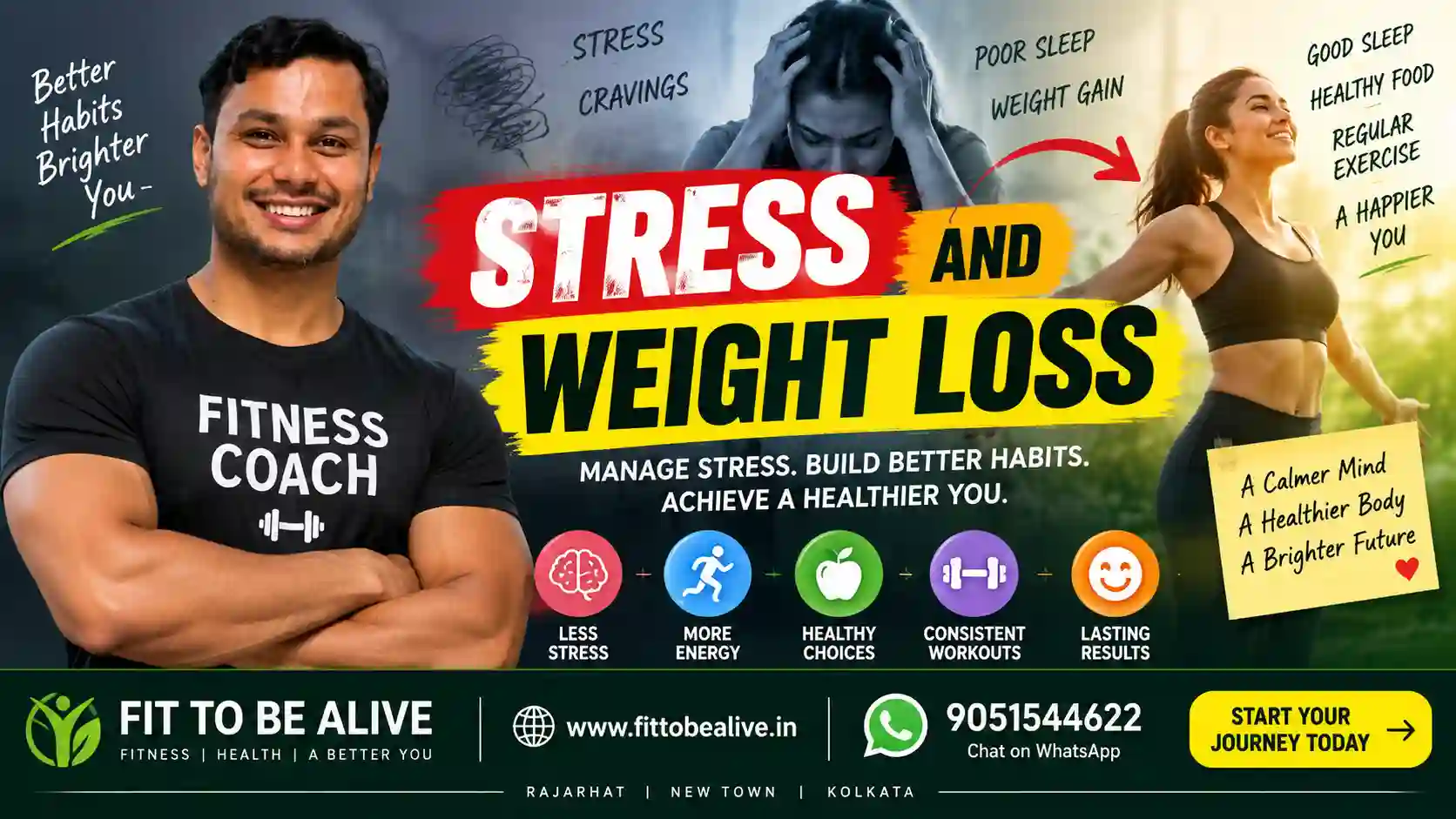
Short answer: Stress can make weight loss harder, but it does not mean that stress automatically causes weight gain or makes fat loss impossible. High or ongoing stress can affect sleep, appetite, food choices, cravings, motivation, and consistency with exercise. That is why I look at stress and weight loss together, rather than treating weight loss as simply “eat less and exercise more.”
I’m Raj Das, Certified Fitness Coach, with 2+ years of experience in the fitness industry. My approach is based on the five essential components of fitness and on building a fitness lifestyle that a person can realistically maintain.
One question I hear from clients is: “Will I actually get results?”
My answer is simple: if you are serious about your transformation, you can make meaningful progress. My job as a coach is to make that journey easier, more practical, and more structured.
For clients in Rajarhat, New Town, Kolkata, I focus on general fitness for adults aged 18–50, including beginners who may feel confused about where to start.
When stress is part of the picture, the goal is not to chase a perfect diet or punish yourself with more exercise. The goal is to build a system that helps you stay consistent.
How Stress Can Affect Weight Loss
Stress is not just a feeling in your mind. It can influence everyday behaviours that matter for weight management.
When someone is under ongoing stress, they may experience changes in sleep, appetite, cravings, motivation, and physical activity. Research has identified connections between mental stress, impaired sleep, increased appetite or cravings, and reduced motivation for physical activity. These factors can make weight-management efforts more difficult.
That does not mean that cortisol is a magical “fat-gain hormone” or that every person with stress will gain weight.
The relationship is much more complicated.
Stress can change your eating routine
Think about a common situation.
You have a stressful day at work. You come home tired. You planned to exercise, but you have no energy. You are also hungry and want something quick and enjoyable.
One difficult day is not the problem.
The problem starts when the same pattern happens repeatedly.
Stress → poor routine → missed workout → convenient food → poor sleep → low energy → another missed workout.
This is the cycle I want clients to break.
Stress can affect sleep
Sleep and stress can influence each other. Poor sleep can make healthy eating and regular exercise more difficult, while stress can interfere with sleep. Research has found associations between stress, sleep, eating behaviour, activity levels, and weight management.
This is why I don’t want a client to believe that the only solution to slow progress is to exercise harder.
Sometimes the better question is:
“What is stopping me from following my plan consistently?”
Does Stress Stop You From Losing Weight?
No.
Stress does not create a rule saying that your body cannot lose fat.
However, stress can make the behaviours required for sustainable weight loss harder to maintain.
Weight management is influenced by many factors, including eating patterns, physical activity, sleep, stress, medications, medical conditions, genetics, environment, and age.
This is why I prefer a body-composition approach rather than focusing only on the number displayed on a weighing scale.
Weight loss is not the only measurement of progress
Your body can change without your progress being perfectly reflected by the scale every day.
Depending on your starting point and training, useful progress markers can include:
-
Body weight trends
-
Waist measurements
-
Strength improvements
-
Fitness levels
-
Exercise consistency
-
Daily activity
-
How your clothes fit
-
Energy and confidence
-
Ability to follow your routine
The important point is to look at progress over time rather than reacting emotionally to one day’s result.
My Practical Framework for Stress and Weight Loss
When I work with a general-fitness client, I prefer a simple framework.
Step 1: Understand the real problem
Before changing everything, identify what is actually going wrong.
Ask yourself:
Is the problem food, exercise, sleep, stress, time management, or consistency?
Sometimes people already know what to do but are not doing it consistently.
That is one of the most common mistakes I see: starting with a goal but failing to build the habits required to reach it.
Step 2: Build a realistic exercise routine
Exercise should fit your current fitness level and lifestyle.
I train beginners across the five essential components of fitness:
-
Cardiorespiratory endurance
-
Muscular strength
-
Muscular endurance
-
Flexibility
-
Body composition
The exact training plan depends on the individual.
For general adult health, WHO recommends at least 150 minutes of moderate-intensity aerobic activity per week, or 75 minutes of vigorous activity, with muscle-strengthening activities involving major muscle groups on at least two days per week. People who are inactive can start with smaller amounts and gradually build up.
That does not mean every beginner needs to immediately train at the maximum recommended level.
Start where you are.
Then progress.
Step 3: Make consistency easier
I would rather see a client follow a sensible plan consistently than follow an extreme plan for two weeks and quit.
Your plan should answer practical questions:
When will I train?
What exercises will I do?
How many days can I realistically commit to?
What will I do when I miss a session?
The last question is especially important.
Missing one workout is not failure.
Turning one missed workout into three weeks away from training is the bigger problem.
Step 4: Improve your daily movement
Exercise is important, but movement does not only happen inside a gym.
Walking, commuting, household activities, recreational activity, and other forms of movement all contribute to physical activity. WHO recognises that physical activity includes movement associated with transport, work, household tasks, recreation, and planned exercise.
For someone in New Town or Rajarhat, this can mean looking for practical opportunities to walk more during the day instead of believing that one workout has to compensate for an otherwise inactive lifestyle.
Step 5: Work on your stress routine
You do not need to eliminate every source of stress before beginning your fitness journey.
Instead, create a few habits that help you manage your routine.
For example:
-
Keep a consistent training schedule.
-
Give yourself enough time to sleep.
-
Plan meals instead of making every food decision when stressed.
-
Take short breaks during demanding workdays.
-
Walk when appropriate instead of remaining seated continuously.
-
Avoid turning one difficult day into an excuse to abandon your goal.
-
Track habits rather than obsessing over daily scale changes.
Stress management is part of a healthy weight-management lifestyle, alongside nutrition, physical activity, and adequate sleep.
The “Brain First” Part of Transformation
One thing I have learned through my experience is that physical transformation is not only about exercise selection.
Your mindset and daily decisions matter.
If your brain is trained to think:
“I missed today, so I have failed,”
you are more likely to quit.
A better approach is:
“I missed today. What can I do tomorrow?”
That small change can make a big difference to consistency.
I believe fitness becomes easier when it gradually becomes part of your lifestyle rather than something you force yourself to do for a short period.
Don’t wait for perfect motivation
Motivation changes.
Your routine should not depend entirely on motivation.
Some days you will feel energetic. Other days you will not.
The goal is to develop enough structure that you can continue even when motivation is lower.
That is one reason I focus on practical training rather than making unrealistic promises.
A Simple Stress-and-Weight-Loss Routine for Beginners
If you are starting from zero, don’t make the plan unnecessarily complicated.
A simple weekly structure
You could begin by combining:
Strength training: 2 or more sessions depending on your ability and programme.
Cardio or active movement: Walking, cycling, or another activity you enjoy.
Mobility and flexibility: Include appropriate movements as part of your fitness routine.
Daily movement: Look for opportunities to be active outside formal workouts.
Recovery: Give sleep and recovery appropriate attention.
The exact frequency, volume, exercises, and progression should be adjusted according to the person’s fitness level and circumstances.
WHO recommends at least 150–300 minutes of moderate aerobic activity per week for adults, alongside muscle-strengthening activity on two or more days per week.
What I Would Not Recommend
Don’t try to “burn off” stress with extreme exercise
More exercise is not automatically better.
Your programme should match your current ability and recovery.
Don’t use extreme dieting as your first solution
Very aggressive restriction can be difficult to sustain. Research also indicates that severe caloric restriction can temporarily increase cortisol, although the relationship between dieting, cortisol, and weight management is complex.
A sustainable approach is usually more useful than constantly moving between restriction and overeating.
Don’t blame cortisol for everything
You may have seen social media claims saying:
“Your cortisol is high, so you cannot lose belly fat.”
That is far too simplistic.
The relationship between cortisol, stress, obesity, abdominal fat, sleep, eating behaviour, and weight management is complex, and research has reported inconsistencies.
Stress matters.
But it is not the only thing that matters.
When You Should Get Medical Guidance
Fitness coaching has boundaries.
My current service is focused on general fitness for adults aged 18–50.
I am currently not trained to provide specialised programming for special populations requiring individualised medical considerations, higher supervision, or medical clearance.
This includes situations such as:
-
Pregnancy
-
Older adults
-
Chronic health conditions
-
Disabilities
-
Other medical or physiological conditions requiring specialised programming
If you have a medical condition, take medication that may affect exercise or weight management, or have been advised to seek medical clearance, speak with an appropriately qualified healthcare professional before starting or changing an exercise programme.
I plan to begin my Special Populations and Nutrition education in March 2027 after completing the required education.
Stress and Weight Loss in Rajarhat and New Town
If you live around Rajarhat, New Town, Kolkata, your fitness journey does not need to look like an influencer’s routine.
You may have a demanding IT or corporate job, long working hours, family responsibilities, commuting, or simply a busy schedule.
Your programme needs to fit your real life.
As a local fitness coach, my goal is to help beginners understand what they are doing, perform exercises properly, develop the five essential components of fitness, and build a routine they can continue.
If your specific goal is weight loss, I approach it through body composition and sustainable lifestyle changes, rather than promising rapid transformations.
My Approach as a Fitness Coach
I don’t believe clients need complicated fitness plans just because fitness information online is complicated.
You need to understand:
What are we trying to achieve?
Why are we doing these exercises?
How will we measure progress?
What happens when life becomes stressful?
How do we make this routine sustainable?
My job is not simply to count repetitions.
I want to guide you through the process and make your fitness journey easier using practical experience.
And if you are serious about your transformation, my answer to the question “Will I get results?” is:
Yes, meaningful results are possible when you commit to the process and work consistently with a suitable plan.
Frequently Asked Questions About Stress and Weight Loss
Can stress make weight loss harder?
Yes. Stress can affect sleep, appetite, cravings, motivation, and physical activity, all of which can make weight-management efforts more difficult.
Does stress automatically cause weight gain?
No. Stress affects people differently, and weight is influenced by many factors. It is more accurate to say that stress can influence behaviours and physiological processes associated with weight management.
Should I stop exercising if I am stressed?
Not necessarily. Appropriate physical activity can support physical and mental wellbeing. The better approach is usually to adjust the training load to your ability, recovery, and circumstances rather than automatically stopping exercise. WHO recommends regular physical activity for adults and notes that some activity is better than none.
How much exercise do I need for weight loss?
There is no single amount that guarantees weight loss for every person. For general health, WHO recommends 150–300 minutes of moderate aerobic activity per week, or an equivalent amount of vigorous activity, plus muscle-strengthening activity on at least two days per week. Your weight-management programme should be individualised.
Is walking useful for weight loss?
Walking is a form of physical activity and can be a practical way to increase daily movement. It can be particularly useful for beginners because it is easy to incorporate into everyday life. However, weight management should be approached as a broader lifestyle programme rather than relying on one exercise alone.
Can I lose weight if I have a stressful job?
Yes, it is possible. A stressful job does not automatically prevent weight loss. The challenge is creating a routine that works around your lifestyle, including appropriate exercise, eating habits, sleep, recovery, and stress management.
What is the biggest mistake people make?
In my experience, one of the biggest mistakes is inconsistency.
People often start with an ambitious goal, follow everything perfectly for a short period, miss a few days, and then stop completely.
I prefer a different mindset:
Build a plan you can continue. Improve it gradually. Stay consistent.
A Practical Takeaway
If stress is affecting your weight-loss journey, don’t immediately assume that your body is “broken.”
Look at the entire system.
Stress → sleep → food choices → daily movement → training → recovery → consistency.
These factors can interact with each other.
Instead of searching for one magical solution, build a lifestyle where healthy choices become easier to repeat.
That is the framework I use with general-fitness clients.
You do not need to become perfect.
You need to become consistent.
And you do not have to figure everything out alone.
If you are a beginner between 18 and 50 in Rajarhat or New Town, Kolkata, and your goal is general fitness or sustainable body-composition improvement, I can help you understand where to start, train the five essential components of fitness, and build a practical routine around your goal.
Your transformation starts with the decision to take action—and then making that action consistent.
