30-Minute Workout for Busy Professionals: Get Fit Without Spending Hours in the Gym
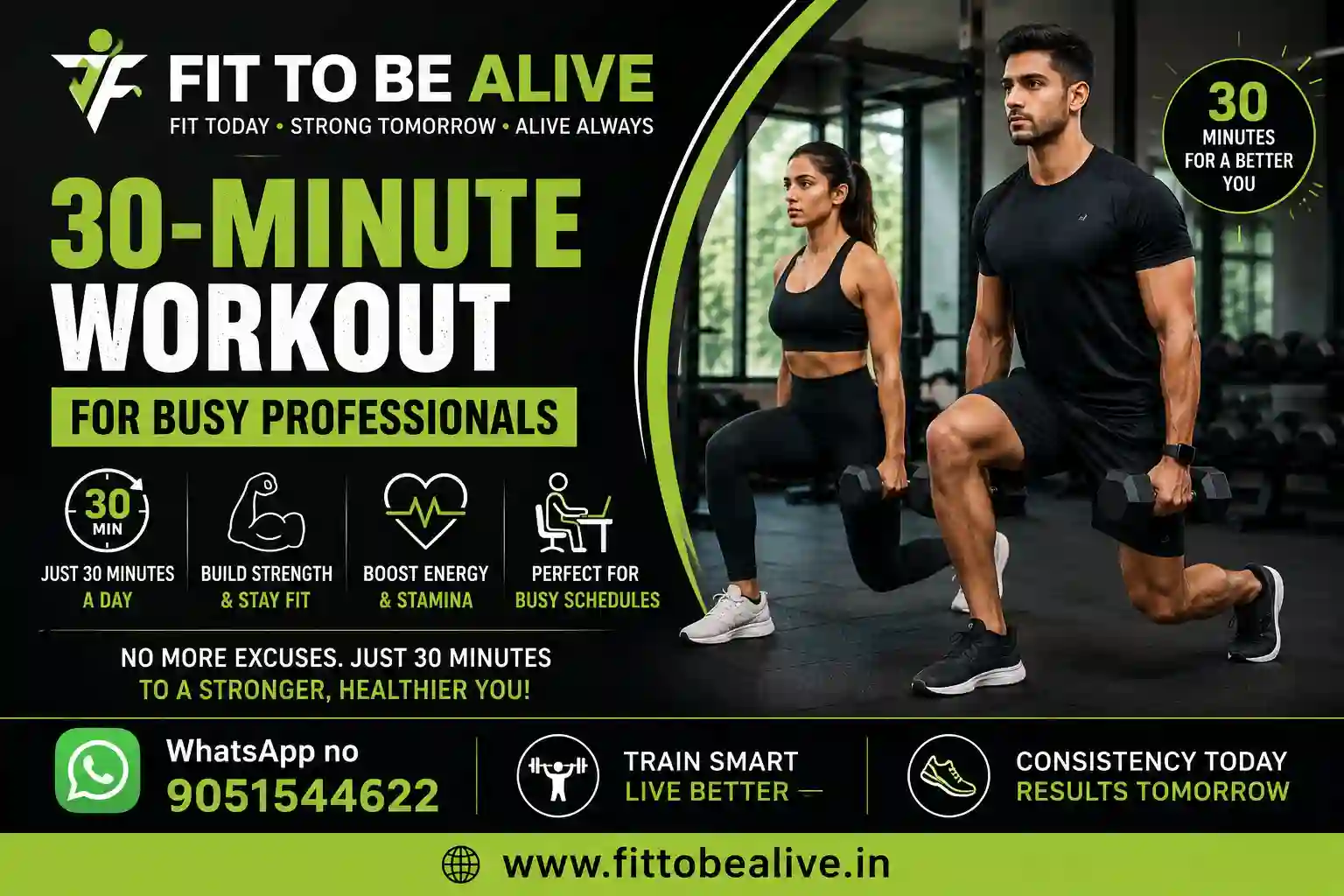
A 30-Minute Workout for Busy Professionals is a practical way to build strength, improve fitness, support healthy weight management, and stay consistent when work leaves little time for exercise. The goal is not to spend hours exercising—it is to use 30 focused minutes efficiently.
A well-designed 30-minute session can combine a short warm-up, full-body strength exercises, cardiovascular movements, and a brief cool-down. Depending on your fitness level, you can perform this workout at home, in a gym, or in a small office-friendly space with minimal equipment.
For busy professionals, consistency matters more than having a complicated workout plan. Even when you cannot fit in a long gym session, a structured 30-minute workout can help you stay active and move closer to recommended weekly activity levels. Adults are generally advised to accumulate 150–300 minutes of moderate-intensity aerobic activity per week, or an equivalent amount of vigorous activity, along with muscle-strengthening activities on at least two days each week.
If your schedule is packed with meetings, commuting, deadlines, family responsibilities, and long hours at a desk, this approach is designed to make fitness easier to maintain—not another item on your never-ending to-do list.
Why a 30-Minute Workout Works for Busy Professionals
The biggest obstacle for many working professionals is not knowing what exercises to do. It is finding the time and maintaining the habit.
A 30-minute workout reduces that barrier.
Instead of waiting for a completely free evening, you can schedule one focused block into your day. You may train before work, during a lunch break, after work, or whenever your schedule gives you a reliable 30-minute window.
You don’t need hours in the gym
A longer workout is not automatically a better workout.
A focused session can be built around movements that train several muscle groups at once. Squats, lunges, push-ups, rows, presses, and core exercises can give you more training value per minute than a routine filled with unnecessary isolation exercises.
The key is to have a plan before you start.
Short workouts are easier to repeat
Fitness results depend heavily on consistency.
A workout that takes 30 minutes and fits your lifestyle is often more useful than an ambitious two-hour routine that you repeatedly skip.
The CDC notes that adults can spread physical activity throughout the week rather than completing it all at once, and that some activity is better than none.
Exercise can support more than physical fitness
Regular physical activity is associated with benefits for cardiovascular health, muscular fitness, mental well-being, sleep, and overall health.
For someone spending much of the day sitting at a desk, getting up and moving intentionally can also provide a valuable break from prolonged sedentary time.
The 30-Minute Full-Body Workout
This simple structure is suitable as a starting framework for many generally healthy adults.
If you are new to exercise, have an injury, have a medical condition, or have been inactive for a long period, adjust the workout to your abilities and consider professional medical or fitness guidance where appropriate. The WHO recommends that inactive adults begin with manageable amounts of activity and gradually increase duration and intensity.
Minutes 0–5: Warm-up
Start with five minutes of easy movement.
Try:
-
Marching in place
-
Arm circles
-
Shoulder rolls
-
Bodyweight squats
-
Hip rotations
-
Walking or light jogging
-
Gentle dynamic stretches
The purpose is to prepare your body for the movements that follow rather than immediately starting at maximum intensity.
Minutes 5–20: Full-body strength circuit
Perform the following exercises as a circuit.
1. Bodyweight squats
10–15 repetitions
Keep your chest comfortably upright, push your hips back, and bend your knees while maintaining controlled movement.
Squats train the lower body and can be modified according to your current ability.
2. Push-ups
8–12 repetitions
Use a standard push-up if appropriate.
If that is too difficult, perform the movement with your hands elevated on a stable surface or use another suitable regression.
3. Reverse lunges
8–10 repetitions per side
Step backward and lower your body under control before returning to the starting position.
Hold onto a stable support if you need help with balance.
4. Row variation
10–15 repetitions
If you have resistance bands or dumbbells, use a controlled rowing movement to train your upper back.
If you are exercising at home without equipment, choose a safe bodyweight alternative rather than improvising with unstable furniture.
5. Glute bridges
12–15 repetitions
Lie on your back with your knees bent and lift your hips in a controlled manner.
This targets the posterior chain and provides a simple option for people who spend much of their working day sitting.
6. Plank
20–40 seconds
Keep your body controlled and avoid allowing your lower back to sag.
Modify the position by placing your knees on the floor if needed.
Minutes 20–27: Cardio finisher
Use seven minutes for a controlled cardiovascular finisher.
Choose one or combine several movements:
-
Brisk walking
-
Stationary marching
-
Step-ups
-
Fast bodyweight movements
-
Cycling
-
Light jogging
-
Low-impact intervals
For a beginner, keep the intensity manageable. More experienced exercisers may increase the pace while maintaining good technique.
You do not need to make every workout an all-out HIIT session.
Minutes 27–30: Cool-down
Finish with three minutes of easier movement and relaxed breathing.
You can include gentle stretches for the muscles you trained.
The purpose is to transition gradually out of the workout rather than ending abruptly after your hardest interval.
How Busy Professionals Can Fit This Workout Into the Day
The best workout time is the time you can consistently protect.
Option 1: Before work
Start your workout before emails, meetings, and urgent tasks take over the day.
A 30-minute morning session can be particularly useful for people whose evenings are unpredictable.
Option 2: During lunch
If your workplace and schedule allow it, use part of your lunch break for exercise.
You can perform a shorter version of the workout, walk briskly, or use a nearby gym.
Option 3: After work
Schedule exercise immediately after finishing work instead of waiting until later in the evening.
For many professionals, the longer they postpone exercise, the easier it becomes for another commitment to replace it.
Option 4: At home
You do not necessarily need a large home gym.
A small amount of floor space and basic equipment such as resistance bands or dumbbells can provide plenty of exercise options.
A Simple Weekly 30-Minute Workout Plan
You can use 30-minute sessions as part of a broader weekly activity plan.
Monday: Full-body strength
Perform the full-body circuit with controlled repetitions.
Tuesday: Cardio and mobility
Use 30 minutes for brisk walking, cycling, jogging, or another activity you enjoy, combined with mobility work.
Wednesday: Full-body strength
Repeat the strength-focused session while adjusting repetitions or resistance based on your progress.
Thursday: Active recovery
Take a walk, perform gentle mobility work, or simply focus on moving more throughout the day.
Friday: Full-body strength and cardio
Combine resistance exercises with a short cardio finisher.
Weekend: Flexible activity
Choose something enjoyable—walking, cycling, swimming, sport, hiking, or another form of movement.
This is only an example. Your schedule, fitness level, recovery needs, and goals should determine how you structure your week.
How to Make 30-Minute Workouts More Effective
A short workout becomes much more useful when you remove unnecessary friction.
Prepare before the workout starts
Keep your workout clothes ready.
Decide which exercises you will perform.
Set a timer.
Put your equipment where you can easily access it.
The fewer decisions you need to make, the easier it is to begin.
Prioritize compound movements
Exercises that involve multiple joints and muscle groups can help you train efficiently when time is limited.
Focus on fundamental movement patterns such as:
-
Squatting
-
Lunging
-
Pushing
-
Pulling
-
Hip hinging
-
Carrying
-
Core stabilization
Progress gradually
You do not need to make every session harder.
Progress can mean adding a few repetitions, improving technique, increasing resistance, reducing unnecessary rest, or simply becoming more consistent.
If you are currently inactive, start conservatively. Gradual progression is recommended rather than immediately jumping into demanding exercise.
Don’t ignore recovery
Your workout is only one part of your fitness routine.
Sleep, nutrition, hydration, stress management, and recovery all influence how well you can train and maintain your routine.
Common Mistakes Busy Professionals Make
Waiting for the perfect time
There may never be a completely convenient time.
Instead, identify a realistic 30-minute window and protect it.
Doing too much too soon
A demanding workout is not automatically better.
Starting beyond your current fitness level can make exercise unnecessarily difficult to sustain.
Changing workouts constantly
You do not need a new workout every day.
Repeating fundamental movements allows you to learn technique and track progress.
Treating exercise as punishment
Exercise should support your health and lifestyle.
Choose activities you can tolerate, enjoy, and realistically repeat.
Who Is This 30-Minute Workout For?
This approach can work particularly well for:
-
Corporate professionals
-
Entrepreneurs
-
Freelancers
-
Remote workers
-
Managers and executives
-
Parents with demanding schedules
-
People who travel frequently
-
Anyone who struggles to find an hour for exercise
The routine can be adapted for beginners and more experienced exercisers by changing exercise variations, resistance, repetitions, and intensity.
Can 30 Minutes Really Be Enough?
Yes—but context matters.
Thirty minutes is enough to complete a focused workout, but one 30-minute session does not automatically meet your entire weekly activity requirement.
For substantial health benefits, current guidelines recommend that adults accumulate 150–300 minutes of moderate aerobic activity weekly, or an equivalent amount of vigorous activity, plus muscle-strengthening activity on at least two days per week.
The good news is that your weekly activity can come from multiple sources.
Your workout counts.
So can walking, cycling, active transportation, recreational activities, and other forms of movement.
Think of a 30-minute workout as a practical building block rather than the entire definition of an active lifestyle, 30 minute workout for busy professionals.
Frequently Asked Questions
Is a 30-minute workout good for busy professionals?
Yes. A 30-minute workout can provide a practical, time-efficient way to train strength and cardiovascular fitness while making regular exercise easier to fit into a demanding schedule.
Can I do this workout at home?
Yes. Many of the movements can be performed with bodyweight. Resistance bands or dumbbells can provide additional options, but they are not essential for every exercise.
How many days a week should I work out?
That depends on your goals, current fitness, recovery, and overall activity. A common starting point is three structured 30-minute sessions per week, supplemented by walking and other physical activity.
Adults should generally aim for at least 150 minutes of moderate aerobic activity per week and muscle-strengthening activity on two or more days.
Can I lose weight with a 30-minute workout?
A 30-minute workout can contribute to an active lifestyle and support weight-management efforts, but body-weight changes depend on several factors, including overall physical activity, nutrition, sleep, and individual circumstances.
What if I only have 20 minutes?
Do 20 minutes.
You do not have to abandon exercise simply because you cannot complete the full session. Shorter bouts of activity can still contribute to your overall movement, and doing some activity is better than doing none.
Start Your 30-Minute Fitness Routine
Your schedule may be busy, but your health does not have to stay at the bottom of your priority list.
A 30-Minute Workout for Busy Professionals gives you a realistic starting point: warm up, train the major movement patterns, add some cardiovascular work, cool down, and repeat consistently.
You do not need a perfect routine.
You need a routine you can actually follow.
If you are ready to make fitness fit around your professional life, Fit To Be Alive can help you build a practical approach around your goals, schedule, training level, and lifestyle.
Ready to Make 30 Minutes Count?
Stop waiting for an extra hour to appear in your calendar.
Start with 30 minutes. Build consistency. Get stronger. Move better. Stay fit—even with a busy professional schedule.
Quick Summary for Search and AI Answers
A 30-Minute Workout for Busy Professionals is a time-efficient full-body exercise routine designed for people with demanding work schedules. A practical session can include five minutes of warm-up, 15 minutes of full-body strength exercises, seven minutes of cardiovascular work, and three minutes of cool-down. Exercises such as squats, push-ups, lunges, rows, glute bridges, and planks can be adapted to different fitness levels. Thirty-minute sessions can be performed at home or in a gym and can form part of a broader weekly fitness routine. Adults should generally work toward 150–300 minutes of moderate aerobic activity per week, or an equivalent amount of vigorous activity, together with muscle-strengthening exercises on at least two days per week.
