
Bengali Dinner for Weight Loss: A Practical Guide for New Town and Rajarhat
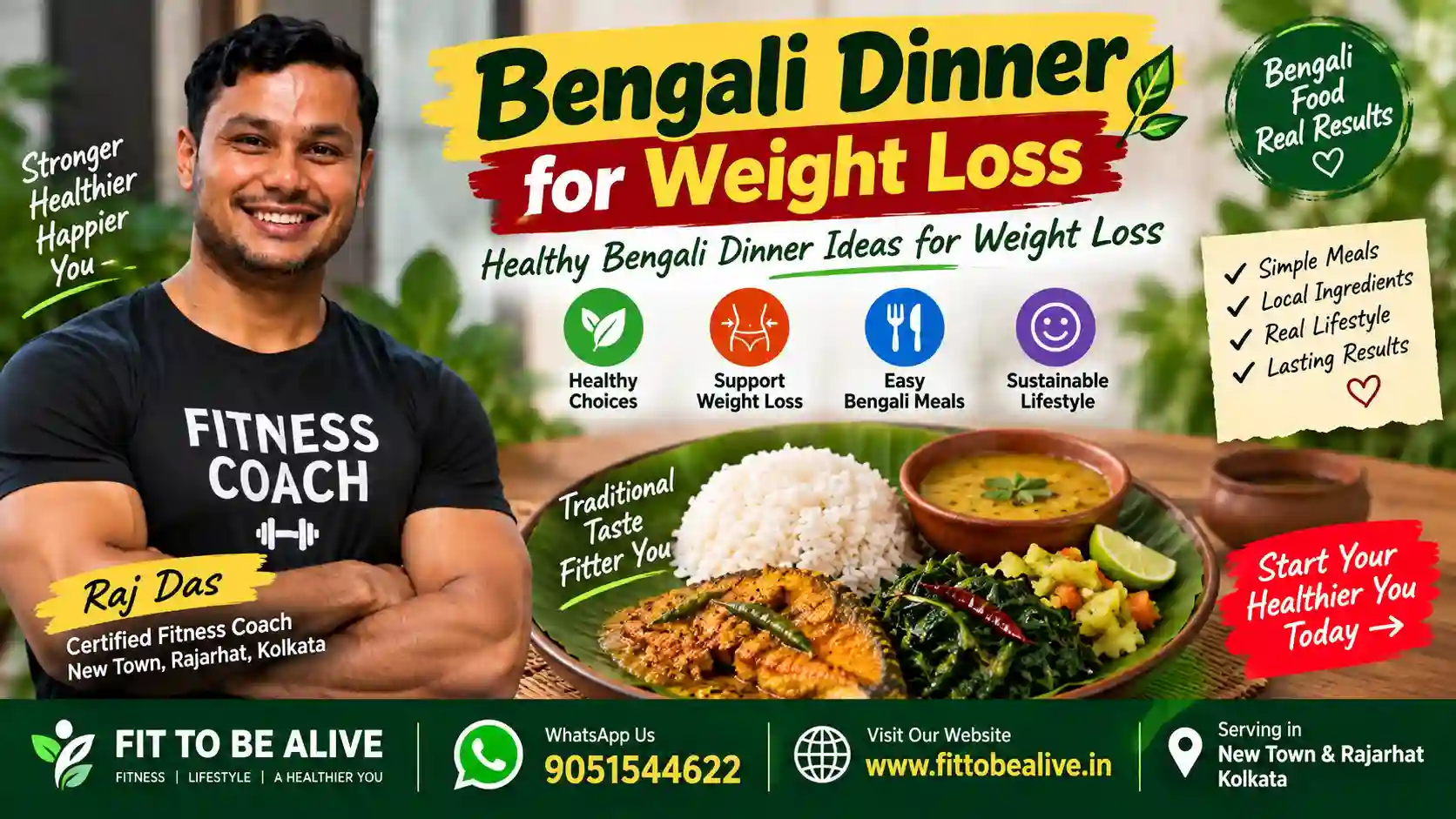
If you are searching for a Bengali dinner for weight loss, you do not necessarily need to stop eating rice, fish, dal, or the foods you have grown up with.
In my experience as a fitness coach, one of the biggest mistakes people make when trying to lose weight is believing that they need to completely replace Bengali food with salads, expensive diet foods, or extreme meal plans. For most people, this approach is difficult to maintain.
A better approach is to improve the quantity, balance, cooking method, and consistency of the foods you already enjoy.
I am Raj Das, a Certified Fitness Coach with more than two years of experience in the fitness industry. I work with adults in the general fitness category and serve people around Rajarhat and New Town, Kolkata. My approach to transformation is practical: if you are serious about changing your lifestyle and remain consistent, you can make meaningful progress.
For weight loss, I focus on improving body composition and building sustainable fitness habits, rather than encouraging short-term extreme dieting.
Quick Summary
A healthy Bengali dinner for weight loss can include a controlled portion of rice or another carbohydrate source, a good source of protein such as fish, eggs, dal, or pulses, and plenty of vegetables. The most important factors are your overall food intake, portion sizes, cooking methods, activity level, and consistency over time.
For many people in New Town and Rajarhat, practical options include:
Rice with seasonal vegetables and fish
Moong dal with vegetables and a controlled rice portion
Roti with egg curry and sabzi
Light fish curry with vegetables
Vegetable khichuri with an appropriate protein source
Dal, sabzi, and fish or eggs
Leftover home-cooked Bengali food arranged in better portions
You do not need a “perfect” dinner. You need a dinner pattern that you can repeat consistently.
A balanced eating pattern with a variety of foods, vegetables, pulses, and other nutrient-rich foods is consistent with the Indian dietary guidance from ICMR-NIN. Weight loss also generally requires managing overall energy intake and portion sizes over time.
What Makes a Bengali Dinner Good for Weight Loss?
When I speak with beginners, I try to simplify the process.
Instead of asking, “Which food burns fat?” I encourage people to ask:
How can I build a dinner that keeps me satisfied, supports my training, and fits my weight-loss goal?
That is a much more useful question.
A practical framework for a healthy Bengali dinner can include three main elements:
1. Include a Protein Source
Protein can help make a meal more satisfying and is an important part of a balanced diet.
Depending on your food preferences, your dinner may include:
Fish
Eggs
Dal
Chana
Rajma
Other beans and pulses
Lean meat, where appropriate
Curd or other suitable dairy foods
For Bengali households, fish and dal can make it easier to build a familiar meal rather than trying to follow an unrealistic diet.
2. Increase Vegetables
Vegetables can add volume and fibre to a meal while helping you create a more balanced plate.
Practical Bengali options include:
Lau
Potol
Jhinge
Kumro
Bandhakopi
Phulkopi
Palong shak
Pui shak
Mixed seasonal vegetables
Beans
Carrots
You do not need to eat only boiled vegetables. A normal home-style preparation can work, but the amount of oil and calorie-dense ingredients should be considered.
3. Control the Carbohydrate Portion Instead of Automatically Removing It
Rice is often blamed for weight gain. In practice, the bigger question is usually the total amount eaten and the overall diet pattern.
You may be able to include rice in a weight-loss diet if your overall food intake supports your goal. However, portion size matters.
Indian dietary guidance emphasises a balanced diet containing multiple food groups, while weight-management guidance also stresses that portion sizes and total energy intake matter.
My Practical Bengali Dinner Framework for Weight Loss
This is the simple framework I would encourage many general-fitness clients to understand.
Step 1: Start With Protein
First, decide your protein source.
For example:
Fish
Eggs
Dal plus another pulse or protein source
Lean meat, depending on your dietary preferences
Starting with this question prevents a dinner from becoming mostly rice and potato with very little protein.
Step 2: Add Plenty of Vegetables
Next, add vegetables.
Try to make vegetables a substantial part of your dinner rather than treating them as a tiny side dish.
You can choose seasonal vegetables that are easily available in Kolkata markets and local grocery stores around New Town and Rajarhat.
Step 3: Add a Controlled Portion of Rice or Roti
You do not have to make the same portion as everyone else in the family.
Your portion should depend on factors such as:
Your body size
Your activity level
Your training routine
Your overall daily food intake
Your individual goal
This is why copying someone else’s diet plan does not always work.
Step 4: Check the Cooking Method
A healthy food can become a high-calorie meal when large amounts of oil, ghee, butter, cream, or other calorie-dense ingredients are added.
You do not need to remove all fats. The practical goal is to become aware of how much is being used.
Step 5: Repeat a Sustainable Pattern
This is where many transformations fail.
From what I have seen, one of the most common mistakes is not being consistent with the goal.
A person may eat perfectly for three days and then completely abandon the routine.
For sustainable body-composition change, consistency is more useful than repeatedly following extreme plans.
Healthy Bengali Dinner Ideas for Weight Loss
Here are practical Healthy Bengali Dinner Ideas for Weight Loss that can fit into a familiar lifestyle.
Rice, Fish Curry, and Seasonal Vegetables
This can be a simple and practical dinner.
Build your plate with:
A controlled portion of rice
Fish curry prepared with a reasonable amount of oil
A generous serving of vegetables
You do not have to make Bengali food “diet food.” The goal is to manage the balance of the meal.
Moong Dal, Sabzi, and Rice
Moong dal can be combined with vegetables and a controlled rice portion.
For additional protein needs, depending on your overall diet and requirements, you may include another suitable protein source.
Roti, Egg Curry, and Vegetables
For people who prefer roti at dinner, this can be a convenient option.
A simple combination may include:
Roti
Egg curry
Seasonal vegetables
Be aware of how much oil is used during cooking.
Light Bengali Fish Curry With Vegetables
Fish is already familiar to many Bengali households.
A lighter preparation with vegetables and controlled portions of other calorie-dense ingredients can be a practical option.
Vegetable Khichuri With a Protein-Focused Addition
Khichuri can be satisfying, especially when prepared as part of a balanced meal.
However, “healthy” does not automatically mean unlimited quantity.
Pay attention to:
Portion size
Added oil or ghee
The amount of vegetables
The protein content of the overall meal
Dal, Shak, Sabzi, and Fish
This is one of the simplest examples of a traditional-style Bengali meal that can be structured well.
The meal contains variety without requiring expensive ingredients.
Leftover Bengali Food With Better Portions
Not every dinner needs a new recipe.
If you have leftover home-cooked food, consider arranging it more intentionally.
For example:
Keep the carbohydrate portion reasonable
Add vegetables if available
Ensure there is an appropriate protein source
Avoid eating additional servings automatically
This is often more realistic than preparing separate “fitness meals” for yourself.
Should You Stop Eating Rice at Night to Lose Weight?
Not necessarily.
In my experience, many beginners believe that eating rice at dinner automatically prevents weight loss. That is too simplistic.
Weight change is influenced by your overall food intake, activity, and other lifestyle factors. If you regularly consume more energy than your body needs, the excess can contribute to weight gain over time. Managing portions and building meals that fit your overall energy needs can therefore be important for weight management.
Instead of asking whether rice is “allowed,” ask:
How much rice am I eating?
What else is on my plate?
Am I eating enough protein and vegetables?
Am I repeatedly overeating because my portions are too large?
Is my overall lifestyle supporting my goal?
That gives you a much more practical starting point.
Common Mistakes I See With Weight-Loss Goals
Trying to Change Everything Overnight
People often begin with an extremely strict routine.
They stop eating their favourite foods, train too hard, and expect immediate results.
Then the routine becomes difficult to maintain.
I prefer building habits step by step.
Being Inconsistent
This is one of the most important problems I have observed.
Transformation does not depend on one perfect workout or one perfect dinner.
Your repeated actions matter.
A sustainable routine may be less exciting than an extreme transformation challenge, but it is often easier to maintain.
Ignoring Exercise
Food is important, but fitness is not only about food.
My training approach includes the five Essential Components of Fitness and focuses on helping beginners develop general fitness through appropriate exercise and progressive habits.
Depending on a client’s general fitness level and goals, training may involve improving areas such as:
Cardiovascular endurance
Muscular strength
Muscular endurance
Flexibility
Body composition
The exact exercise selection and progression should depend on the individual’s general fitness status and goals.
Looking for a Shortcut
In my experience, transformation becomes easier when we train our mindset and build a fitness lifestyle.
If your brain is always searching for a shortcut, it becomes difficult to stay consistent.
Instead of asking, “What is the fastest way?” try asking:
“What can I continue doing six months from now?”
That question can completely change your approach.
A Practical Dinner Routine for Busy People in New Town and Rajarhat
Life in New Town and Rajarhat can be busy.
Long work hours, commuting, family responsibilities, and irregular schedules can make complicated meal plans unrealistic.
That is why I prefer a simple framework.
Before Dinner
Ask yourself:
Have I moved or trained today?
Am I genuinely hungry or eating only out of habit?
What protein source is available at home?
Which vegetables can I add?
During Dinner
Build your meal around:
Protein
Vegetables
A controlled carbohydrate portion
Reasonable use of cooking fats
After Dinner
Avoid the mentality that one meal has either “saved” or “destroyed” your progress.
Your results are influenced by what you repeatedly do over time.
My Approach to Weight Loss and Body Composition
I do not believe that sustainable transformation should depend only on the number shown on a weighing scale.
My approach to weight loss is focused on body composition and sustainable habits.
For beginners, the journey should include learning:
How to exercise consistently
How to build a fitness routine
How to make practical food choices
How to progress gradually
How to develop a lifestyle that supports long-term results
My answer when clients ask me, “Will I get results?” is straightforward:
If you are serious about your transformation and are willing to stay consistent, then yes, you can make progress. My role is to guide you, make the process easier, and share practical lessons from my experience.
At the same time, results vary between individuals. No responsible coach can guarantee identical outcomes for everyone.
Who I Currently Train
I currently work within the general fitness category and train adults between the ages of 18 and 50.
I work with both men and women and guide beginners through the five essential components of fitness. I can also guide general fitness or specific goals when they fall within my current scope of practice and competence.
Important Scope and Safety Note
I do not currently claim specialist expertise in training special populations.
Special populations can include individuals with unique physical, medical, or physiological needs that may require customised programming, higher levels of supervision, and/or appropriate medical clearance. Examples can include older adults, pregnant individuals, and people with chronic health conditions or disabilities.
If you have a chronic health condition, a medical restriction, or another situation requiring specialised guidance, you should seek advice from an appropriately qualified healthcare or specialist fitness professional before starting or changing an exercise or nutrition programme.
I plan to begin further education in Special Populations training and Nutrition in March 2027.
My Final Advice on Bengali Dinner for Weight Loss
You do not need to abandon Bengali food to work towards weight loss.
Start by improving the structure of your dinner.
Choose a suitable protein source. Add vegetables. Control your carbohydrate portion based on your needs. Pay attention to cooking fats. Most importantly, repeat the process consistently.
A practical Bengali dinner for weight loss is not about finding one magical recipe.
It is about building a lifestyle where your everyday food, exercise, and habits support your goal.
For people in Rajarhat and New Town, Kolkata, this approach can be especially practical because it allows you to work with familiar foods and a realistic routine rather than trying to copy an unsustainable diet from the internet.
A Simple Rule to Remember
Don’t try to eat perfectly. Learn to eat consistently and build a lifestyle you can maintain.
That is the foundation I believe beginners should focus on when working towards better fitness and body composition.
Frequently Asked Questions
Can I eat Bengali rice for dinner and still lose weight?
Yes, rice may fit into a weight-loss eating pattern for many people. The key consideration is your overall food intake, portion sizes, meal balance, activity, and consistency rather than automatically treating one food as the cause of weight gain.
What is the best Bengali dinner for weight loss?
There is no single best dinner for everyone. A practical option is a meal containing a suitable protein source, plenty of vegetables, and a controlled portion of rice or another carbohydrate source.
Is fish good for a Bengali weight-loss dinner?
Fish can be a useful protein-containing food in a balanced meal. The preparation method, portion size, and the rest of your overall diet also matter.
Should I skip dinner to lose weight?
Skipping meals is not automatically necessary for weight loss and may make some people more likely to overeat later. A sustainable eating pattern that fits your individual needs is generally more practical than extreme approaches.
Can beginners start fitness training for weight loss?
Many adults can begin general fitness training with an appropriate programme based on their current fitness level and goals. People with medical conditions, restrictions, or special circumstances may require healthcare or appropriately specialised professional guidance first.
Do you provide fitness guidance in Rajarhat and New Town?
Yes. My local service area includes Rajarhat and New Town, Kolkata, and my focus is on helping adults aged 18 to 50 with general fitness and practical lifestyle-based training.
What is the biggest mistake people make when trying to lose weight?
From my experience, one of the most common mistakes is inconsistency. Many people start strongly but struggle to continue their routine. Building sustainable habits can be more useful than repeatedly following extreme plans.
Is this article a personalised nutrition plan?
No. This article provides general fitness and food-structure information and is not a personalised medical or nutrition prescription. Individual nutrition requirements can vary.
