
Bengali meal plan for busy professionals
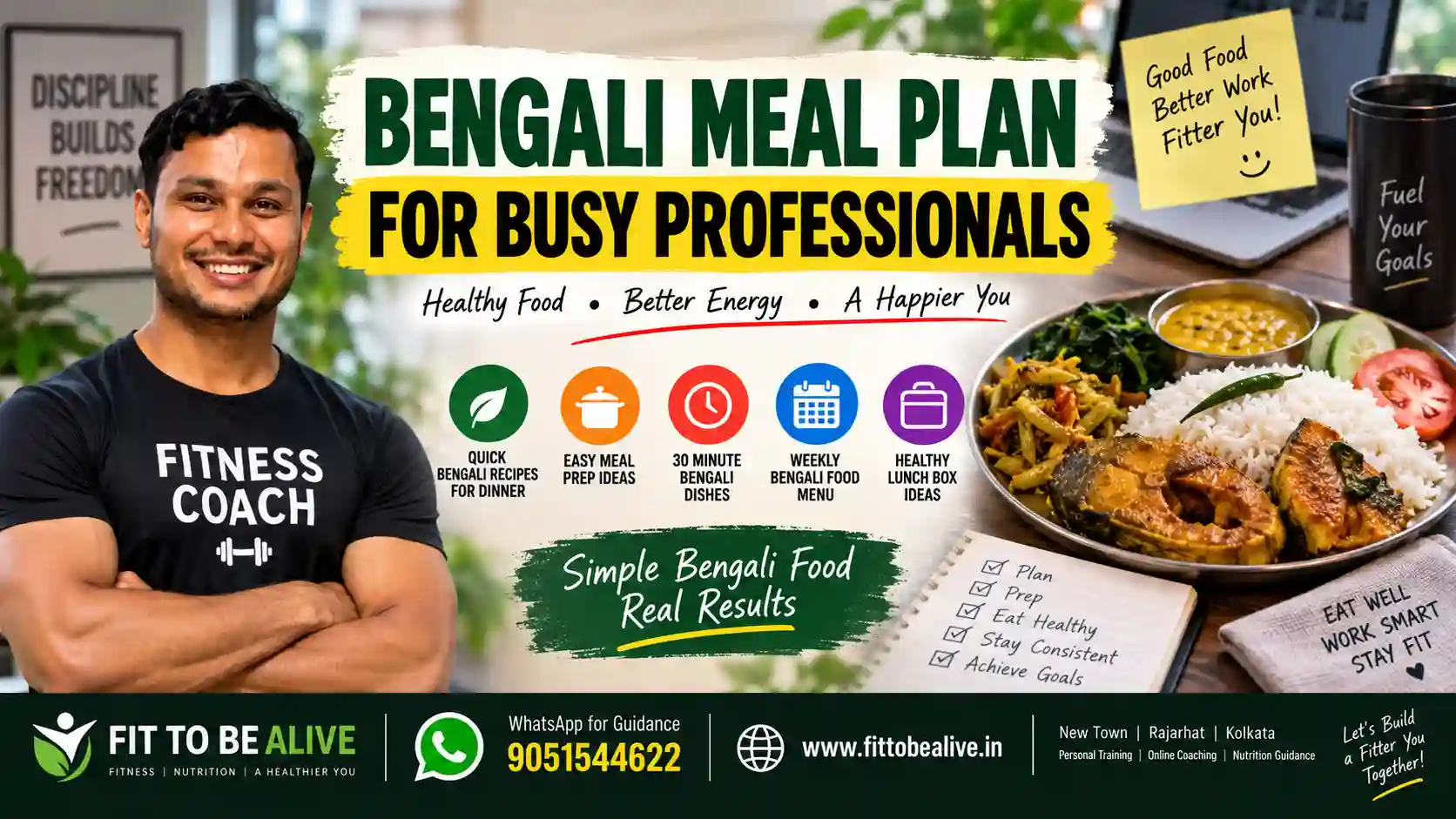
If you live in New Town, Rajarhat, or anywhere around Kolkata, you already know the problem: work gets busy, meetings run late, commuting takes time, and eating well becomes one more thing to manage.
For many Bengali professionals, the solution is not giving up rice, dal, মাছ, vegetables or familiar home-style food. The better approach is to make Bengali food work with your lifestyle.
A practical meal plan should help you answer simple questions: What should I eat before work? What can I carry for lunch? What can I cook quickly after coming home? How can I manage portions if my goal is fat loss? And how can I stay consistent when my schedule changes?
That is the approach I use when discussing nutrition and general fitness with clients.
A practical Bengali food framework for busy working people
I am Raj Das, a Certified Advanced Personal Trainer with more than two years of experience in the fitness industry. My knowledge covers human anatomy, exercise science, physiology, kinesiology, biomechanics, nutrition, posture correction and functional training.
My approach combines strength training, practical nutrition and yoga-based mobility and flexibility work. I work with general-fitness clients between 18 and 55 years old, including beginners, and I help people work towards goals such as weight loss, muscle building, fat loss, body recomposition, posture improvement, mobility and general fitness.
One lesson I repeatedly see is that the biggest problem is often not a lack of information.
It is inconsistency.
You may know what a healthy meal looks like, but if the plan takes too long to prepare, does not fit Bengali eating habits, or becomes impossible during a busy workweek, following it becomes difficult.
So instead of creating a complicated diet, I prefer a framework you can actually repeat.
The 5-part Bengali meal planning framework
Think about your meals through five simple questions:
Protein: What is my main protein source?
Vegetables: Where can I add vegetables or other fibre-rich foods?
Carbohydrates: What portion of rice, roti or another carbohydrate fits my meal?
Cooking method: Can I keep everyday cooking simple instead of relying heavily on fried foods?
Consistency: Can I realistically follow this meal tomorrow, next week and during a busy workday?
This is more useful than searching for a “perfect” Bengali diet.
Your exact food requirements can vary according to your body size, activity level, goals, preferences and individual circumstances. A general meal framework should therefore be treated as a practical starting point rather than a personalised medical nutrition prescription.
Sample day for a busy Bengali professional
A simple working day could look like this:
Breakfast: Eggs or another protein-rich option with roti, oats or another convenient carbohydrate, plus fruit or vegetables where practical.
Lunch: Rice in a sensible portion with dal, fish/chicken/eggs or another protein source, vegetables and a suitable side.
Evening: A simple snack such as fruit, curd/yogurt, eggs or another convenient option that helps prevent arriving at dinner extremely hungry.
Dinner: A lighter, balanced Bengali-style meal built around protein, vegetables and an appropriate carbohydrate portion.
The important point is not that everyone must eat these exact foods.
The important point is creating meals that are simple enough to repeat.
Easy Bengali meal prep ideas for the working week
Meal preparation does not have to mean spending your entire Sunday cooking.
Start with components.
You can prepare a basic dal, wash and cut vegetables, boil eggs, portion cooked rice and prepare a protein source in advance. Store ingredients safely and use them to assemble different meals through the week.
For example, the same prepared vegetables can accompany rice and fish at lunch and eggs or another protein at dinner.
This reduces daily decision-making.
For busy professionals, that matters because nutrition often becomes difficult when every meal requires a fresh decision.
A useful rule is:
Prepare ingredients, not necessarily seven identical meals.
That gives you flexibility when your work schedule changes.
Quick Bengali recipes for dinner
After a long day, dinner should not become a second job.
Some practical Bengali-style options include:
Egg curry with vegetables and a controlled rice portion
Simple fish curry with rice and vegetables
Dal with mixed vegetables and an appropriate protein source
Light chicken curry with vegetables
Egg bhurji-style preparation with roti and vegetables
Fish or chicken prepared with simple spices rather than a complicated cooking process
The goal is not to make traditional food “fitness food.”
The goal is to make everyday food easier to portion and easier to fit into your overall routine.
30 minute Bengali dishes can make consistency easier
A useful weekday target is to keep several meals simple enough to prepare in around 30 minutes.
For example, you can keep eggs, fish, chicken, dal, vegetables and basic Bengali spices available so that you are not forced to order food whenever you are tired.
You can also create a short list of emergency meals.
When I work with beginners, I find that having a backup plan is often more practical than expecting perfect discipline every day.
Your backup meal might simply be:
Protein + vegetables + sensible carbohydrate portion.
That is enough to prevent one hectic evening from turning into an entire week of poor eating decisions.
Healthy Bengali lunch box ideas for New Town and Rajarhat professionals
Lunch is one of the biggest challenges for office workers.
If you are travelling to an office in New Town, Rajarhat or nearby areas, your lunch box does not need to be complicated.
A practical lunch box can include:
Rice with fish and vegetables
Rice with dal, eggs and vegetables
Roti with chicken and vegetables
Rice with a suitable protein source and dal
Leftover home-cooked food arranged into sensible portions
If you usually become hungry soon after lunch, look at the meal as a whole rather than automatically blaming rice.
Ask:
Did I include enough protein? Did I include vegetables? Was the meal satisfying? Was my portion appropriate for my goal and activity?
This way of thinking is more sustainable than automatically removing one food.
Weekly Bengali food menu: use a repeatable structure
Instead of planning seven completely different breakfasts, lunches and dinners, create a flexible weekly structure.
Monday: Fish + rice + vegetables
Tuesday: Eggs + roti/rice + vegetables
Wednesday: Chicken + rice + vegetables
Thursday: Fish + dal + rice + vegetables
Friday: Eggs or another protein + roti/rice + vegetables
Saturday: A preferred Bengali meal with sensible portions
Sunday: Home-cooked meal with flexibility for family or social eating
You can change the foods according to your preferences, budget, availability and household cooking.
The framework matters more than the exact menu.
What about weight loss?
My approach to weight loss is centred on improving body composition and building habits that can be maintained.
I do not believe that success requires completely abandoning Bengali food.
Rice can be part of a balanced eating pattern. So can dal, fish, eggs, vegetables and traditional home-cooked meals.
For someone trying to reduce body fat, the bigger picture matters: total food intake, protein intake, physical activity, resistance training, sleep, recovery and consistency all influence the process.
I also encourage clients to think beyond the weighing scale.
Changes in body composition, strength, fitness, waist measurements, performance and everyday habits can provide useful context.
The biggest mistake I see: inconsistency
One of the common mistakes I see is starting with an extremely strict plan and then abandoning it when real life becomes busy.
Monday may be perfect.
Then Tuesday brings meetings.
Wednesday brings late work.
Thursday becomes a restaurant meal.
By Friday, the person decides the plan has “failed.”
I prefer a different mindset.
One imperfect meal does not require an imperfect week.
Return to the framework at the next meal.
This is where I believe the mental side of fitness becomes important. Transformation becomes much more practical when you train your brain to treat fitness as a lifestyle rather than a short-term challenge.
Who my general fitness training is for
My general fitness training is designed for adults aged 18 to 55, including beginners.
I can guide clients through general fitness using the five essential components of fitness:
Cardiovascular endurance
Muscular strength
Muscular endurance
Flexibility
Body composition
Depending on the person’s goal, training may include weight training, functional exercises, mobility work, flexibility work and yoga-based practices.
For example, a beginner may first need to learn movement patterns, build basic strength and improve consistency before progressing to more demanding training.
The programme should match the person’s current ability rather than simply copying an advanced workout.
My training boundaries
I currently work within the general-fitness category.
I am not currently offering specialised training for special populations, including older adults requiring specialised programming, pregnant individuals, people with chronic health conditions, or people with disabilities who require specialised supervision or medical clearance.
These groups can have unique physical, medical or physiological requirements and may require a higher level of individualisation and professional oversight.
I plan to begin specialised Special Populations training and Nutrition education in March 2027, after completing the relevant education.
If you have a medical condition or another situation requiring specialised care, appropriate medical or qualified professional guidance should come first.
Why local guidance can make a difference
Fitness advice becomes easier to apply when it reflects real life.
If you live or work around New Town, Rajarhat or Kolkata, your schedule, commute, food availability, family meals and social occasions all influence your routine.
My goal is not to make you follow an unrealistic lifestyle.
It is to help you build a system around the lifestyle you actually have.
That can mean learning how to manage rice portions, planning an office lunch, preparing food before a busy week, choosing practical meals after training, or fitting strength training around work.
Your next step
You do not need a perfect meal plan to begin.
You need a structure you can follow consistently.
Start by choosing a few breakfasts, lunches and dinners that you genuinely enjoy. Prepare some ingredients in advance. Keep simple backup meals available. Combine sensible portions with regular physical activity and strength training.
If your goal is weight loss, muscle building, fat loss, better mobility, posture improvement, body recomposition or general fitness, the process becomes easier when your nutrition and training support each other.
I am Raj Das, Certified Advanced Personal Trainer, providing general fitness guidance in New Town, Rajarhat and Kolkata.
If you are serious about your transformation, my role is to make the journey more practical, structured and easier to follow through my training knowledge and practical experience.
Start with consistency. Build the fitness lifestyle. Then progress from there.
