
Portion Control Bengali Food: A Practical Weight-Loss Framework for New Town & Rajarhat
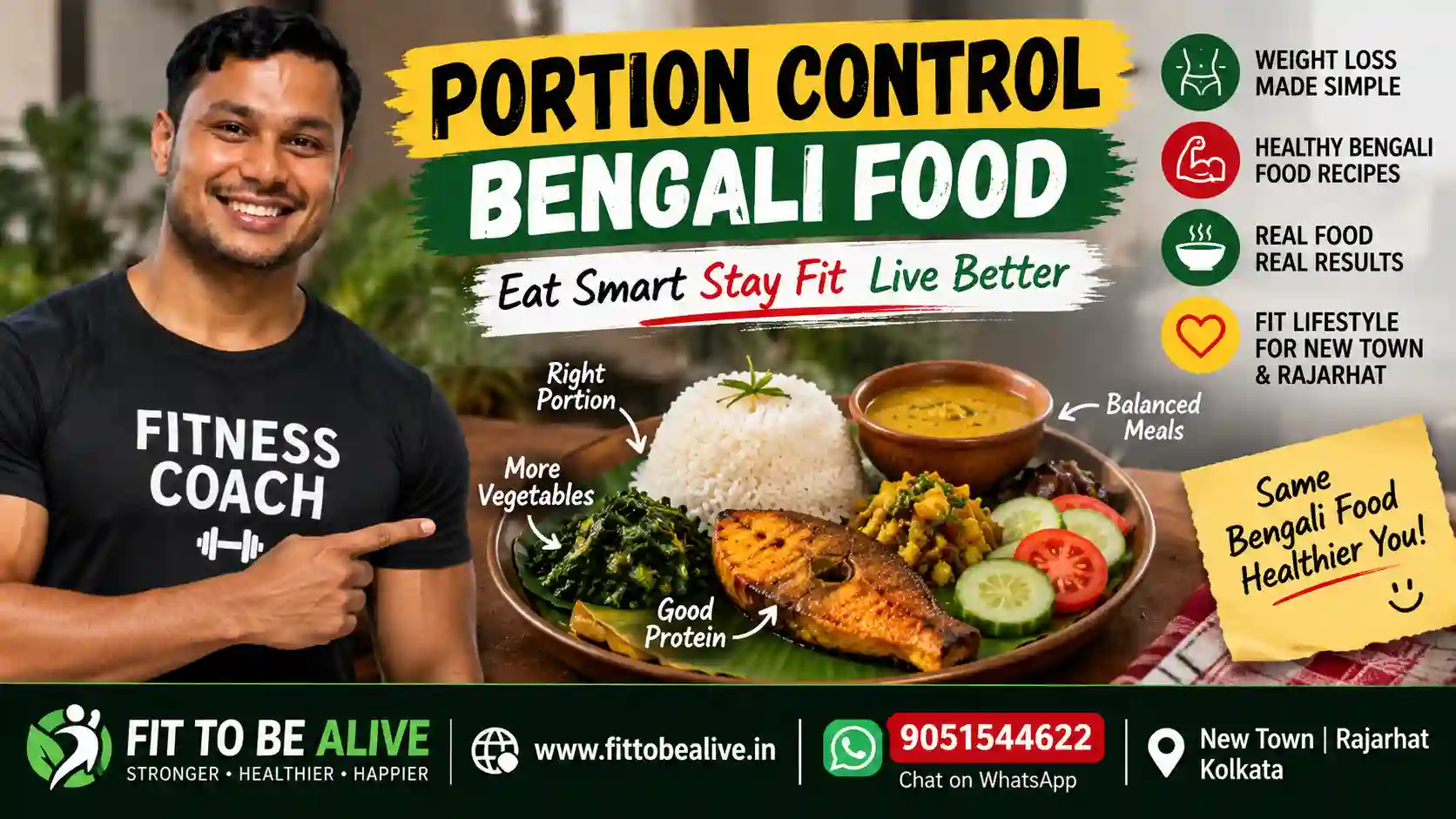
If you love Bengali food but think you need to give up rice, fish, dal, vegetables or your favourite home-cooked meals to lose weight, you don’t.
The practical approach is to learn portion control with Bengali food, build balanced meals, stay consistent with training and gradually create a lifestyle that you can actually maintain.
In my experience as a personal trainer, the biggest problem is often not that people don’t know what healthy food is. The problem is that they struggle to control portions, manage eating patterns, stay consistent with their goal and fit fitness into real life.
For someone living in New Town, Rajarhat or Kolkata, there is no reason to follow a completely unfamiliar diet just because you want to lose body fat. Your regular Bengali meals can be part of the plan.
Quick summary: how portion control works with Bengali food
You can eat Bengali food while working towards weight loss by focusing on portion size, meal balance, protein, vegetables, cooking methods and consistency.
A simple meal framework is:
Keep rice or roti to a portion that suits your overall calorie and activity needs.
Include a meaningful protein source such as fish, eggs, chicken, dal or another suitable protein.
Add plenty of vegetables or seasonal Bengali preparations.
Be mindful of oil, fried foods, sweets and calorie-dense additions.
Eat slowly enough to notice when you are comfortably satisfied.
Don’t treat one large meal as failure. Return to your normal routine at the next meal.
Combine nutrition with resistance training, cardiovascular work, mobility and an appropriate activity routine.
The goal is not to stop eating Bengali food. The goal is to make your everyday Bengali food work better for your goal.
Why portion control matters more than banning Bengali food
One of the most common questions I hear is:
“Can I lose weight if I continue eating rice and Bengali food?”
The answer depends on your overall food intake, activity, individual requirements and consistency. Simply removing one food does not automatically create a sustainable plan.
Rice is not automatically responsible for weight gain. The same applies to fish, dal or potatoes. What matters is the overall pattern, including the amount you eat and how the meal fits into your daily nutrition.
This is where portion control Bengali food becomes useful.
Instead of asking:
“Which Bengali food should I completely stop?”
ask:
“How can I build my Bengali meal so the portion supports my goal?”
That small change in thinking can make a diet much easier to follow.
My simple Bengali meal portion framework
I prefer a framework over a rigid meal plan because everyone’s body, activity level, food preferences and daily routine are different.
1. Start with vegetables
Make vegetables an important part of your lunch and dinner.
Think about familiar foods such as:
Lau
Potol
Begun
Bandhakopi
Phulkopi
Beans
Mixed vegetables
Seasonal leafy vegetables
Other locally available vegetables
The cooking method matters too. A vegetable preparation cooked with a lot of oil can be much more energy-dense than a lighter preparation.
You don’t have to make Bengali food boring. The objective is to become more aware of how the food is prepared.
2. Add protein
Protein is an important part of a balanced eating pattern, particularly when your goal also includes maintaining or building muscle while reducing body fat.
Your Bengali meals can include options such as:
Fish
Eggs
Chicken
Dal
Curd or other suitable dairy foods
Other protein sources according to your dietary preference
Instead of building your plate primarily around rice, think about the meal as rice + protein + vegetables, with portions adjusted to your individual requirements.
3. Control your rice portion
You do not automatically need to remove rice.
The practical question is how much rice fits into your overall diet.
If you currently eat a very large serving, reducing it gradually can be easier than suddenly eliminating it.
For example, rather than filling your plate with rice first and trying to fit everything else around it, serve a sensible rice portion and then add your protein and vegetables.
This is one of the simplest ways to practise portion control with Bengali food without making your meals feel completely different.
Bengali diet chart for weight loss: use a framework, not a punishment diet
A Bengali diet chart for weight loss should fit the person’s lifestyle.
A practical day might look like this:
Breakfast:
Eggs with roti, or another balanced breakfast based on your food preference.
Lunch:
A controlled rice portion + fish/dal/another protein source + vegetables.
Evening:
A simple snack such as fruit, curd or another suitable option depending on your daily requirements.
Dinner:
Protein + vegetables + a controlled carbohydrate portion if it fits your plan.
This is only a framework, not a personalised prescription.
Your calorie and nutrient requirements can vary depending on factors such as body size, activity level, training, age, food preferences and goal.
That’s why copying someone else’s “7-day diet chart” is not always the best approach.
Healthy Bengali food recipes: make familiar food work for you
You don’t need complicated “fitness food” to improve your diet.
Some simple ideas include:
Lightly prepared fish with vegetables
Dal with a sensible serving of rice and vegetables
Egg-based meals with vegetables
Chicken with Bengali-style spices and vegetables
Seasonal vegetable preparations using a controlled amount of oil
Homemade meals where you can control the ingredients and portions
When preparing healthy Bengali food recipes, pay attention not only to the main ingredient but also to the amount of oil, frying, sugar and other calorie-dense ingredients used during cooking.
A food can be nutritious and still contribute a significant amount of energy if the portion is very large or the preparation uses a lot of added fat.
Low calorie Bengali food: don’t focus only on calories
People often search for low calorie Bengali food because they want a list of “safe” foods.
I prefer to teach people how to build a meal instead.
Vegetables, certain lean protein choices and lighter cooking methods can help you create meals that provide good volume without making the entire meal extremely energy-dense.
But remember: “low calorie” does not automatically mean “eat unlimited amounts.”
Your entire day’s intake still matters.
The same principle applies to traditional Bengali foods. You don’t have to label foods as completely good or bad. Instead, understand their role, portion and frequency.
Bengali food calorie chart: why numbers are not always exact
A Bengali food calorie chart can be useful as a general reference, but don’t treat every number you find online as an exact measurement.
Calories can change depending on:
Portion size
Ingredients
Amount of oil or ghee
Cooking method
Recipe
Brand or food source
Raw versus cooked weight
For example, two preparations of the same fish may have very different calorie values depending on how they are cooked.
That’s why I don’t want clients becoming obsessed with a single number.
Learning portion awareness and understanding your overall diet is often more practical for long-term consistency.
How to lose weight eating Bengali food
If someone asks me how to lose weight eating Bengali food, I would start with five questions:
1. What does your normal day of eating look like?
Don’t start by changing everything.
First understand your existing routine.
2. Where are your portions getting too large?
Rice, snacks, fried foods, sweets, restaurant meals and weekend eating can all contribute depending on the person.
3. Are you eating enough protein and vegetables?
A balanced meal can be easier to manage than a meal dominated by one food group.
4. Are you training consistently?
Nutrition is only one part of body composition.
My approach combines appropriate exercise with nutrition rather than treating weight loss as a food-only problem.
5. Can you follow this routine for months?
This is the question I consider extremely important.
A plan that works for ten days but becomes impossible afterward isn’t a practical long-term strategy.
My approach: focus on body composition, not only the weighing scale
My approach to weight loss is centred around body composition and sustainable lifestyle changes.
I use training methods that can include:
Cardiovascular endurance
Muscular strength
Muscular endurance
Flexibility
Body composition
Depending on the person’s goal, training may include weight training, functional exercises, cardiovascular work and yoga-based mobility or flexibility work.
The goal isn’t simply to make someone lighter.
The goal is to help a person build a healthier and more capable body while developing habits they can continue.
The biggest mistake I see: inconsistency
One of the common mistakes I have seen is inconsistency with the goal.
Someone follows a plan for a few days, then misses training, overeats at a social event, feels guilty and decides the entire plan has failed.
It hasn’t.
One meal doesn’t define your progress.
The better approach is to return to your routine.
I believe transformation becomes much more realistic when your brain starts accepting fitness as part of your lifestyle rather than treating it as a temporary challenge.
Your environment, habits, food choices, sleep, training and consistency all matter.
What I teach beginners in New Town and Rajarhat
I work with beginners within my general fitness training scope.
For adults aged 18 to 55, my general fitness approach can include training across the five essential components of fitness: cardiovascular endurance, muscular strength, muscular endurance, flexibility and body composition.
I also guide people towards specific goals such as:
Weight loss
Fat loss
Muscle building
Hypertrophy
Body recomposition
Strength
Functional fitness
Postural correction
Mobility and flexibility
General fitness
My exercise selection is based on movements and training methods I actually use for general fitness, while specific goals are addressed according to the person’s needs and training level.
My professional boundaries matter
I currently work within my general fitness training scope.
I do not currently provide specialised programming for special populations requiring additional medical clearance, higher supervision or specialised education.
This includes situations such as pregnancy, older-adult populations, chronic health conditions and disabilities.
I also don’t want to pretend to have expertise that I have not yet completed training for.
I plan to begin specialised Special Populations training and Nutrition education in March 2027, after completing the relevant education.
If you have a medical condition or require specialised exercise or nutrition support, appropriate medical or qualified specialist guidance should come first.
Meet Your Coach: Raj Das
I’m Raj Das, Certified Advanced Personal Trainer, with 2+ years of experience in the fitness industry.
My core knowledge and understanding include:
Human anatomy
Exercise science
Physiology
Kinesiology
Biomechanics
Nutrition
Posture correction
Functional training
My guidance can include weight training for strength, nutrition guidance within my scope, and yoga-based mobility and flexibility work.
My training approach covers all five essential components of fitness: cardiovascular endurance, muscular strength, muscular endurance, flexibility and body composition.
I work with people in New Town, Rajarhat and Kolkata, especially beginners who want practical guidance rather than complicated fitness rules.
If you want Bengali food to stay in your life, build a system around it
You don’t need to abandon your food culture to work towards a healthier body.
You need a practical system.
Start by controlling portions.
Then improve meal balance.
Add appropriate protein.
Eat more vegetables.
Be aware of cooking methods.
Train consistently.
Learn from your mistakes instead of giving up.
And most importantly, build a fitness lifestyle that you can continue after the initial motivation disappears.
That’s the approach I try to bring to my clients in New Town and Rajarhat.
If you’re serious about your transformation, my job is to help make the journey simpler, more structured and practical.
Ready to start? Contact Raj Das at Fit To Be Alive for general fitness and personal training in New Town, Rajarhat, Kolkata.
