
Bengali Nonvegetarian Diet Weightloss
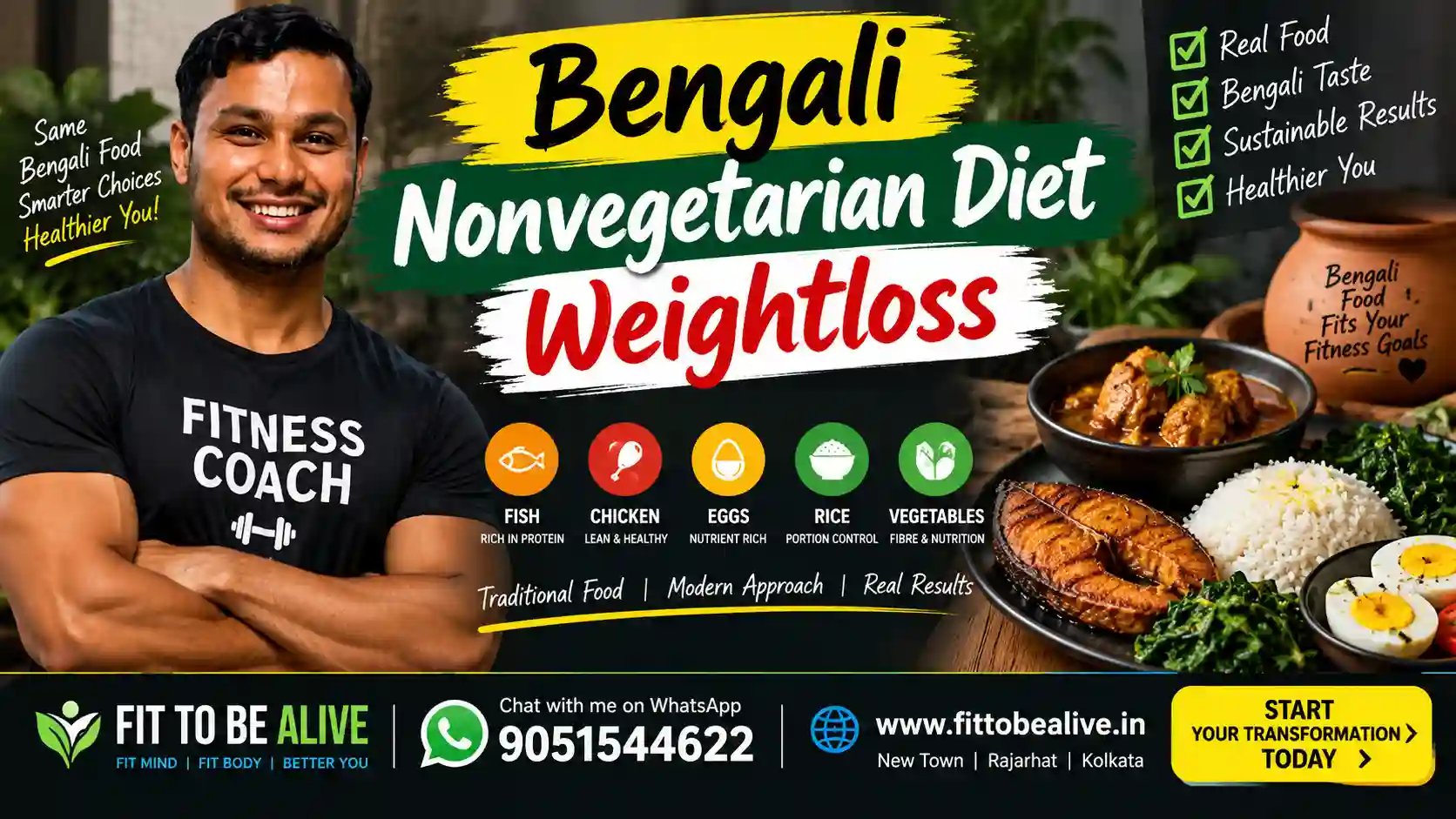
If you are searching for a Bengali nonvegetarian diet weightloss plan, you probably do not want another diet that tells you to stop eating rice, fish, eggs or chicken.
As a Certified Fitness Coach working with beginners, I understand that your diet has to fit your real life. For someone living in New Town, Rajarhat or Kolkata, Bengali food is part of everyday life. Fish curry, rice, dal, vegetables, eggs and chicken can all have a place in a sensible weight-loss approach.
My approach is simple: do not try to build a temporary diet. Build a fitness lifestyle that you can actually continue.
I have worked with people who ask me one question before starting: “Raj, will I really get results?”
My answer is straightforward: if you are serious about your transformation and willing to stay consistent, progress is possible. My job is to make that journey more practical, easier to understand and easier to follow.
Can you lose weight while eating Bengali non-vegetarian food?
Yes, a Bengali diet does not automatically prevent fat loss.
The bigger issue is usually the overall pattern: how much you eat, how often you eat, cooking methods, portions, protein intake, vegetables, activity, sleep and how consistently you follow the plan.
A sustainable approach does not require eliminating every food you enjoy.
Instead, I prefer looking at body composition and lifestyle habits. The goal is not simply to see a smaller number on the weighing scale. We want to develop habits that support a healthier body while maintaining useful muscle and fitness.
This is why your regular Bengali foods can be reorganized rather than completely removed.
My practical Bengali weight-loss framework
Think about your daily food using four simple questions:
1. Where is my protein?
Fish, eggs and chicken can be practical protein choices. ICMR-NIN also recognizes fish, poultry and eggs among animal-source protein foods.
2. Where are my vegetables and fibre-rich foods?
Vegetables, pulses, fruits and other minimally processed foods can help create a more balanced eating pattern. WHO recommends dietary diversity and encourages adults to consume vegetables and fruit regularly.
3. How much cooking oil and fried food am I having?
A food can be nutritious while the overall meal becomes very calorie-dense because of preparation, portion size or added fats.
4. Can I follow this plan next month?
This is the question many people forget.
A plan that works for five days and collapses on the weekend is not a sustainable plan.
Bengali weight loss diet chart non veg: a practical structure
Instead of giving everyone exactly the same menu, I recommend building meals around a repeatable structure.
Breakfast
Choose one protein-focused option with a sensible carbohydrate source.
Examples include:
-
Eggs with vegetables and roti
-
Egg bhurji with vegetables
-
Boiled eggs with a simple breakfast
-
Oats with eggs on the side
-
A Bengali-style breakfast adjusted for portion size
Tea or coffee can be included, but be aware of how much sugar you regularly add.
Lunch
A practical Bengali lunch could contain:
-
Rice in a controlled portion
-
Fish or chicken
-
Dal
-
One or two vegetable preparations
-
Salad or additional vegetables where practical
You do not necessarily need to remove rice to lose body fat.
The portion and the total meal matter.
Evening snack
This is where many people unintentionally turn a good diet into a high-calorie diet.
Instead of automatically reaching for biscuits, fried snacks or sugary drinks, consider:
-
Boiled eggs
-
Fruit
-
Unsweetened or lightly sweetened tea
-
A measured portion of nuts
-
Curd or another suitable protein-containing option
Dinner
Dinner can follow the same basic structure as lunch, but your portion requirements should depend on your overall daily intake and activity.
For example:
-
Fish with vegetables
-
Chicken with vegetables and a moderate carbohydrate portion
-
Egg-based meal with vegetables
-
Fish curry with vegetables and a suitable rice portion
The objective is not to make dinner unnecessarily tiny. The objective is to make your overall day sustainable.
Non veg Bengali diet chart for weight loss PDF: what you should know
Many people search for a Non veg Bengali diet chart for weight loss pdf because they want one ready-made chart they can download and follow.
A PDF can be convenient, but a fixed chart is not automatically a personalized diet.
Two people can have completely different calorie and nutrient requirements depending on factors such as body size, activity, training, food preferences and health status.
So I would rather teach you the framework behind the meal plan than tell you that one PDF is perfect for everyone.
Use a chart as a reference, not as a substitute for individualized professional nutrition guidance.
What about a 1200 calorie Bengali diet chart non veg?
You may also see searches for a 1200 calorie Bengali diet chart non veg.
Here I want to be careful.
1,200 calories is not a universal target for every adult. Whether a particular calorie intake is appropriate depends on the individual. A very aggressive restriction can also make it harder for some people to maintain training, energy and consistency.
That is why I do not recommend choosing 1,200 calories simply because the number appears in a diet chart online.
A better approach is to understand your current food intake, activity, body-composition goal and practical lifestyle before deciding how much you should eat.
For sustainable weight management, consistency matters enormously. CDC guidance also emphasizes realistic eating patterns, physical activity, sleep and stress management rather than relying on a short-term diet alone.
Healthy Bengali food for weight loss
You do not need expensive “diet food” to eat better in Kolkata.
Some practical choices include:
Fish: Choose regular fish preparations while paying attention to portion size and how much oil is used during cooking.
Eggs: Eggs can be a convenient protein-rich food for breakfast, lunch or a snack.
Chicken: Skinless chicken prepared with moderate oil can fit into many balanced meal patterns.
Dal: Dal can complement a meal with protein, carbohydrate and fibre.
Vegetables: Lau, begun, potol, beans, cauliflower, cabbage, spinach and other locally available vegetables can make meals more filling and varied.
Rice: Rice does not have to disappear. Adjusting the portion can be more practical than eliminating it completely.
Fruit: Seasonal fruit can be a convenient alternative to many highly processed snacks.
The larger principle is variety, balance and moderation. WHO specifically notes that a healthy diet should reflect individual needs, cultural context and locally available foods.
Bengali weight loss recipe non veg: keep cooking simple
A good Bengali weight loss recipe non veg does not have to taste like “diet food.”
Try modifying familiar meals rather than abandoning them.
Light fish curry
Use your preferred fish, plenty of tomato/onion/spices as appropriate, vegetables if suitable, and control the amount of cooking oil.
Egg and vegetable bhurji
Eggs with onion, tomato, spinach or other vegetables can make a quick meal when you do not have time for elaborate cooking.
Simple chicken curry
Use a sensible portion of chicken, plenty of flavour from spices, and control the oil rather than relying on a heavy gravy.
Fish with vegetables
A simple fish preparation combined with a generous serving of vegetables can be one of the easiest meals to repeat during a busy working week.
The trick is not finding one “magic” recipe.
The trick is having several meals that you genuinely enjoy and can repeat.
The biggest Bengali weight-loss mistakes I see
In my experience, the biggest problem is often not a lack of information.
It is inconsistency.
Someone follows a diet perfectly from Monday to Friday and then treats Saturday and Sunday as completely separate days.
Another common mistake is trying to compensate for overeating by starving the next day.
Others remove rice completely, become frustrated, and eventually return to their old eating pattern.
Some people also focus only on cardio and ignore strength training.
I prefer a broader approach because fitness has more than one component. My training method covers the five essential components of fitness, with exercise selection adjusted according to the person’s general fitness level and specific goal.
Diet alone is not the complete transformation
Fat loss and fitness are connected to your overall lifestyle.
For adults, WHO recommends at least 150 minutes of moderate-intensity physical activity per week, or an equivalent amount of vigorous activity, together with muscle-strengthening activity on at least two days per week.
That does not mean a beginner needs to suddenly train like an athlete.
Start at an appropriate level.
Walking, resistance training, mobility work, cardiovascular exercise and progressive improvement can all have a place in a structured fitness routine.
The exact exercise programme should depend on your current ability and goal.
Train your brain before trying to transform your body
This is one of the biggest lessons I have learned while working with people.
Transformation becomes easier when your brain starts accepting fitness as part of your lifestyle instead of treating it as punishment.
You do not need to be perfect.
You need to become consistent.
One missed workout does not destroy your progress. One restaurant meal does not destroy your progress. The problem is when one missed day becomes one missed week, and one weekend becomes a permanent excuse.
Build the habit again at the next opportunity.
Who I currently train
My general fitness training is for adults aged 18–55, both men and women.
I work with beginners and people who want guidance toward a specific general-fitness goal. My approach is practical: understand where you are starting, identify the goal, and build a routine that you can realistically follow.
I currently stay within the general-fitness category.
I do not currently provide specialized training for people who require customized programming, higher supervision or medical clearance because of pregnancy, chronic health conditions, disabilities or other special-population needs.
I am planning to begin special-population training and nutrition education after completing my additional education in March 2027.
If you have a medical condition or have been advised to seek medical supervision before changing your diet or exercise routine, please speak with your qualified healthcare professional first.
Bengali nonvegetarian diet weightloss for New Town, Rajarhat and Kolkata
If you live around New Town, Rajarhat or Kolkata, your plan should fit your actual lifestyle.
Your working hours matter.
Your commute matters.
Your family meals matter.
Your Bengali food preferences matter.
Your access to a gym or training space matters.
Your previous fitness experience matters.
That is why I prefer practical coaching over giving someone a generic list of foods and saying, “Follow this for 30 days.”
If you want sustainable results, we need to build habits that can survive your normal week—not just your most motivated week.
What results should you expect?
I never want to promise a specific amount of weight loss to everyone because individual results are different.
Your results can be influenced by your starting point, food intake, activity, sleep, stress, consistency, medications, health conditions and other factors.
What I can promise is a practical coaching approach.
If you are serious about your transformation, I will help you understand what to do, how to make it practical and how to stay consistent.
The goal is not simply to finish a diet.
The goal is to develop a fitness lifestyle.
Ready to start your transformation?
If you are looking for a Bengali nonvegetarian diet weightloss approach that respects Bengali food, practical routines and sustainable body-composition goals, start with the basics.
Eat with structure.
Keep protein sources in your meals.
Include vegetables and varied whole foods.
Manage portions.
Reduce the frequency of heavily fried and highly processed foods.
Move regularly.
Strength train appropriately.
And most importantly, stay consistent.
For people in New Town, Rajarhat and Kolkata, I provide general fitness guidance for adults aged 18–55, including beginners and people working toward specific general-fitness goals.
If you are ready to stop searching for another temporary diet and start building a lifestyle you can maintain, you can explore my Personal Training or Online Coaching options and get in touch to discuss your fitness goal.
Your transformation does not need to begin with a perfect plan. It needs to begin with a plan you can actually follow.
