

The short answer on how to build muscle is simple. Lift weights three days a week, take every set within about two reps of failure, and add weight or reps over time. Eat 1.4 to 2 grams of protein per kilogram of body weight with a small calorie surplus, and sleep at least seven hours. Do this for months and an adult man can gain roughly 0.25 to 0.9 kg of muscle per month.
Most people do not fail because the science is hard. They change programs every three weeks, guess their protein, use the same dumbbells for half a year, and expect a new body by the wedding season. Fast muscle building is about wasting less time, not finding a secret.
This guide walks you through four steps: a weekly workout, the lifting rules that make it work, a food plan with real numbers, and recovery. Fit To Be Alive coaches muscle gain in New Town, Kolkata, so the food examples fit Indian plates and busy office schedules.
How muscle grows and what you need first
Muscle grows when you challenge it with resistance, then give your body enough protein, calories and rest to rebuild it slightly bigger. Every step below serves one of those three inputs.
The three inputs that drive growth
Your muscles constantly break down and rebuild protein. You gain size only when your body adds more protein than it removes, and lifting is the signal that pushes the balance that way. Walking, cardio and yoga support your health, but resistance against moderate to heavy loads is the only reliable trigger for growth.
- Training: enough hard sets on each muscle every week.
- Food: enough protein and a modest calorie surplus.
- Recovery: sleep, plus rest days between sessions for the same muscles.
Muscle is built by hard training, but it is paid for with food and sleep.
What fast really looks like
Fast has a ceiling. With good training and nutrition, 0.25 to 0.9 kg of muscle per month is the benchmark for adult men, and the pace is highest in your first year. The table shows what that adds up to if the rate held. In reality it slows as you get trained, so treat the top of each range as a beginner’s best case.
| Time | Muscle gained if the benchmark holds |
|---|---|
| 1 month | 0.25 to 0.9 kg |
| 6 months | 1.5 to 5.4 kg |
| 12 months | 3 to 10.8 kg |
Scale weight can jump faster than this, because water, food in your gut and fat all count. Anyone promising 10 kg of muscle in two months is counting something other than muscle. Judge your progress by strength, waist and photos.
What to set up before session one
You need less than you think. Gather these before you start:
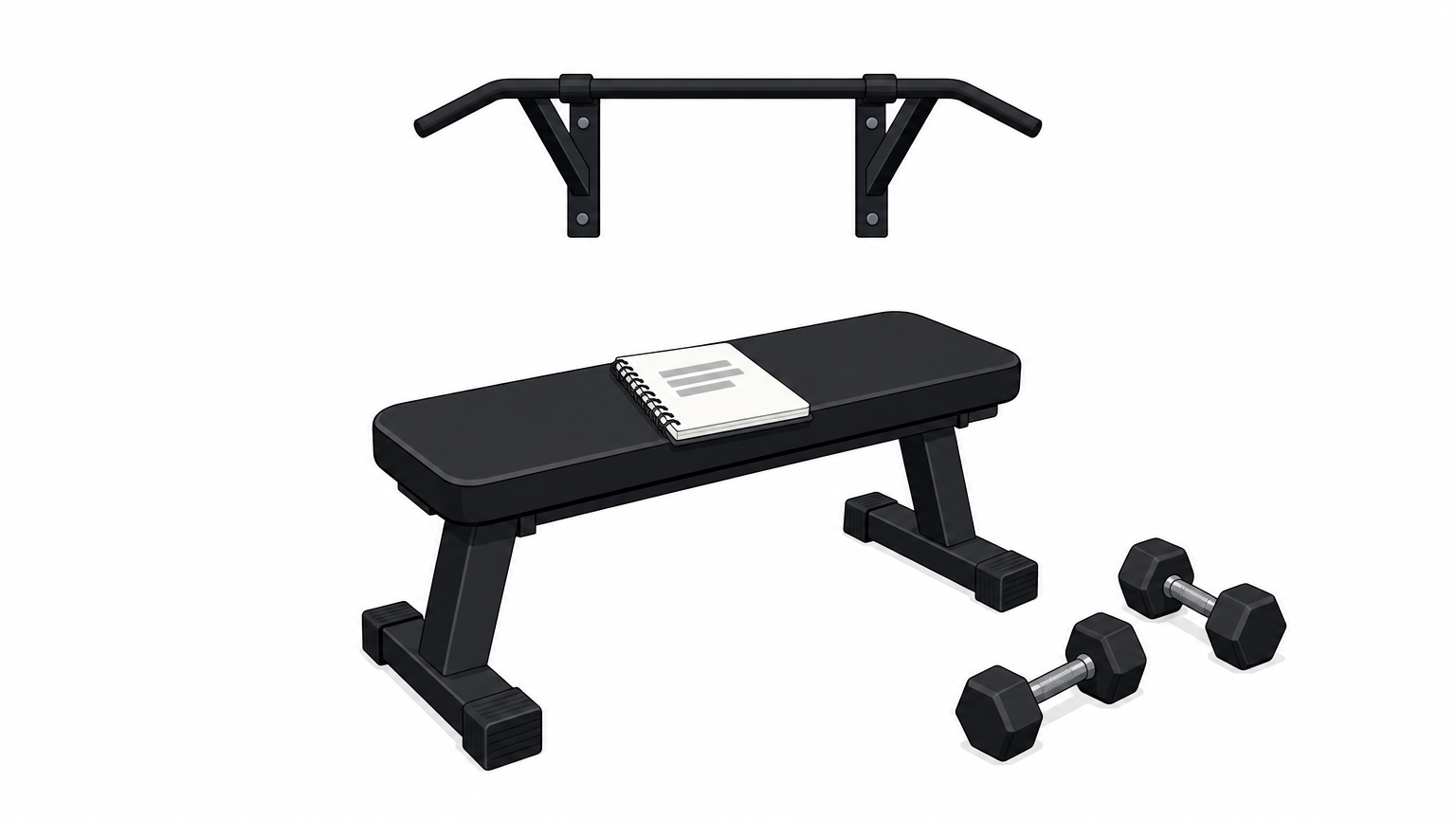
- A pair of adjustable dumbbells, a bench and a pull-up bar, or access to your society gym.
- A notebook or phone note for logging every set.
- A weighing scale and a tape measure.
- A doctor’s go-ahead if you have a heart, blood pressure or joint problem, or have been inactive for years.
Step 1. Build your weekly workout
Train your whole body three days a week with a rest day between sessions, for example Monday, Wednesday and Friday. Use two alternating workouts of six exercises, three sets each.
Why three full-body days work
Two full-body sessions a week already produce measurable strength changes. Three sessions give every muscle three growth signals per week, which is why this split suits most beginners and office workers. Leave at least 48 hours between sessions that hit the same muscles, and keep each workout to five to seven exercises so you can recover from it.
Three hard full-body sessions a week beat six scattered ones.
A workout to gain muscle, ready to use
Alternate the workouts: Workout A, B, A in week one, then B, A, B in week two. Warm up with five minutes of easy movement and one or two light sets of your first exercise. A session takes about an hour.
| Workout | Exercise | Sets × reps |
|---|---|---|
| A | Goblet or barbell squat | 3 × 8 to 10 |
| A | Dumbbell bench press | 3 × 8 to 12 |
| A | One-arm dumbbell row | 3 × 8 to 12 |
| A | Dumbbell shoulder press | 3 × 8 to 12 |
| A | Dumbbell biceps curl | 3 × 10 to 12 |
| A | Plank | 3 × 30 to 45 seconds |
| B | Romanian deadlift | 3 × 8 to 10 |
| B | Walking lunge | 3 × 10 per leg |
| B | Pull-up or lat pulldown | 3 × 6 to 10 |
| B | Push-up | 3 × 8 to 15 |
| B | Triceps pushdown or overhead extension | 3 × 10 to 12 |
| B | Standing calf raise | 3 × 12 to 15 |
Prefer free weights over machines where you can, since they train balance and stabilizers too. Use machines if balance or an injury makes sitting safer. Do not skip legs, because squats, deadlifts and lunges work the biggest muscles in your body in one movement.
Get your form checked early
A written plan cannot see your lower back rounding on a Romanian deadlift. Film your sets from the side, or ask a coach to watch the first few sessions. Fit To Be Alive offers three routes. Fit Starter is free, with self-learning videos and live Q&A on Wednesday and Saturday. Fit Transformation costs ₹2,000 per month for live group coaching over Zoom. Fit Elite costs ₹5,000 per month for one-to-one training at your home or society gym.
Step 2. Lift in the right range and add load
Work in the 8 to 12 rep range, finish each set within about two reps of failure, and add weight or reps whenever you complete the top of the range. Muscle only keeps growing if the stimulus keeps getting harder.
Pick the weight by effort, not by number
Heavy sets of 1 to 5 reps build more strength, sets of 8 to 12 build more muscle, and sets above 15 build more endurance. The ranges overlap, so a set of 20 still grows muscle if it is hard enough. The practical rule is proximity to failure. By the last rep of a set of 10, you should be unable, or nearly unable, to do another. If you routinely finish with more than two reps left, the weight is too light.
Use the lower end of the range for squats and deadlifts and the higher end for curls and calf raises. Lower the weight under control for two to three seconds instead of dropping it. A slow descent keeps the muscle loaded longer and protects your joints.
A set only counts toward growth when the last reps are genuinely hard.
Add load with double progression
Double progression gives you a simple rule for when to go heavier. Follow it for every exercise:
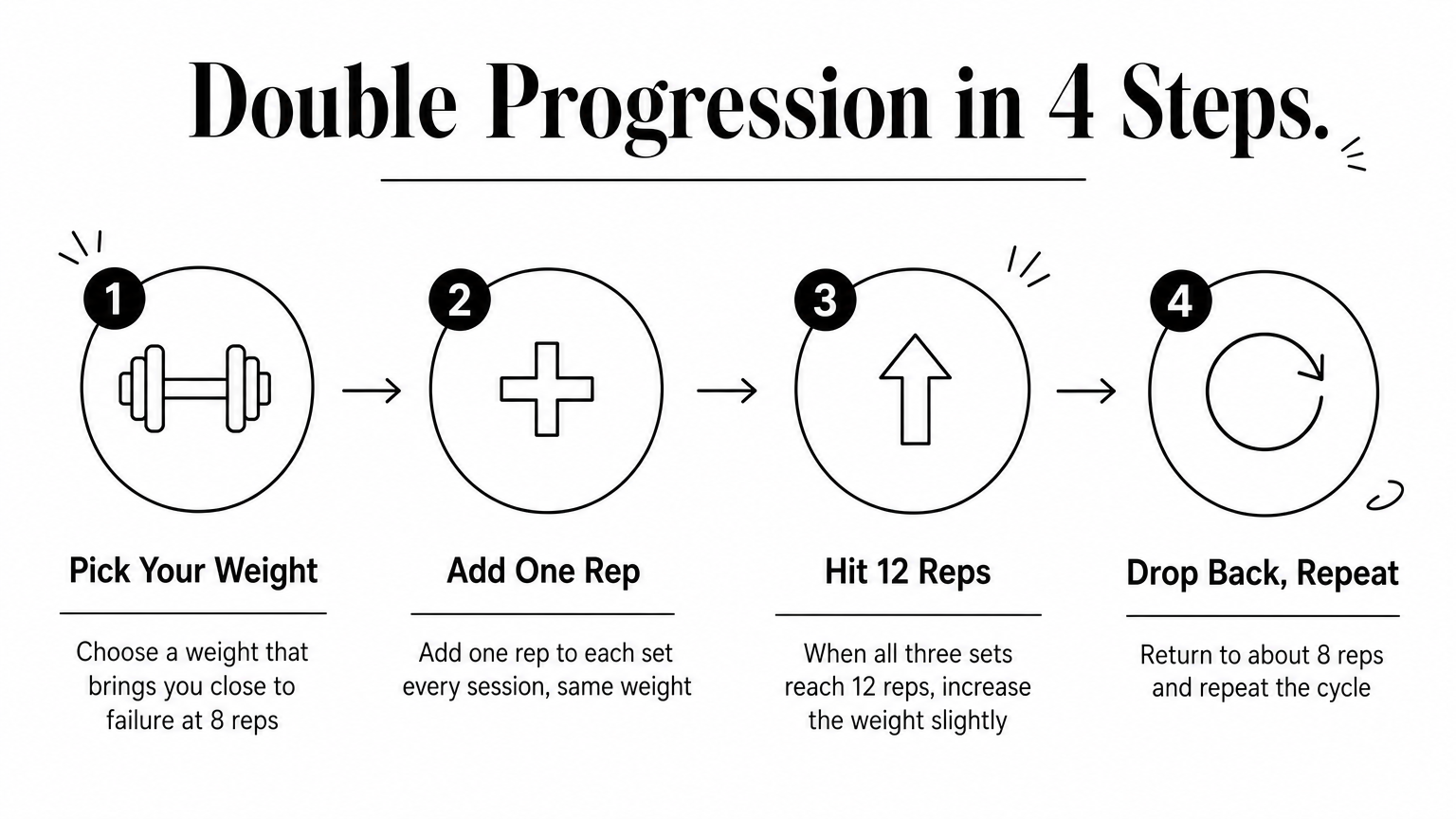
- Choose a weight that brings you close to failure at about 8 reps.
- Each session, try to add one rep to each set while keeping the same weight.
- When all three sets reach 12 reps, increase the weight by the smallest jump available, usually 1 to 2.5 kg for dumbbells.
- Drop back to about 8 reps and repeat.
Logging makes this work, because you cannot beat numbers you do not remember. Copy this format into your notes for each exercise:
Date:
Workout: A
Exercise: Dumbbell bench press
Weight: 20 kg
Reps, sets 1 / 2 / 3: 10 / 9 / 8
Reps left in the tank: 2
Step 3. Eat enough protein and calories
Eat about 300 to 500 calories above your maintenance level and 1.4 to 2 grams of protein per kg of body weight every day. The worked example below uses a 70 kg man.
Set a calorie target
Your maintenance calories, or total daily energy expenditure, depend on age, sex, lean mass, daily activity and job. Estimate yours with an online TDEE calculator, then add 300 to 500 calories. Your body has a maximum muscle-building rate, so anything beyond that surplus is stored as fat.
Say the calculator gives 2,400 calories for your 70 kg body. Your target is 2,700 to 2,900 calories per day. Start at 2,700 and move up only if your lifts and weight both stall.
Hit your protein number
Research on athletes suggests 1.4 to 2 grams of protein per kg per day for people training to gain muscle. For a 70 kg man that is 98 to 140 grams, and 1.6 g/kg, or 112 grams, is a sensible middle. Split it over four meals, about 28 grams each, and take 20 to 40 grams within an hour after training.
| Food | Protein |
|---|---|
| 3 oz (about 85 g) lean chicken | 24 g |
| 8 oz (about 225 g) plain Greek yogurt | 23 g |
| 1 cup cooked lentils | 18 g |
| 3 oz (about 85 g) salmon | 17 g |
| 2 eggs | 13 g |
| 1 oz (28 g) peanuts | 7 g |
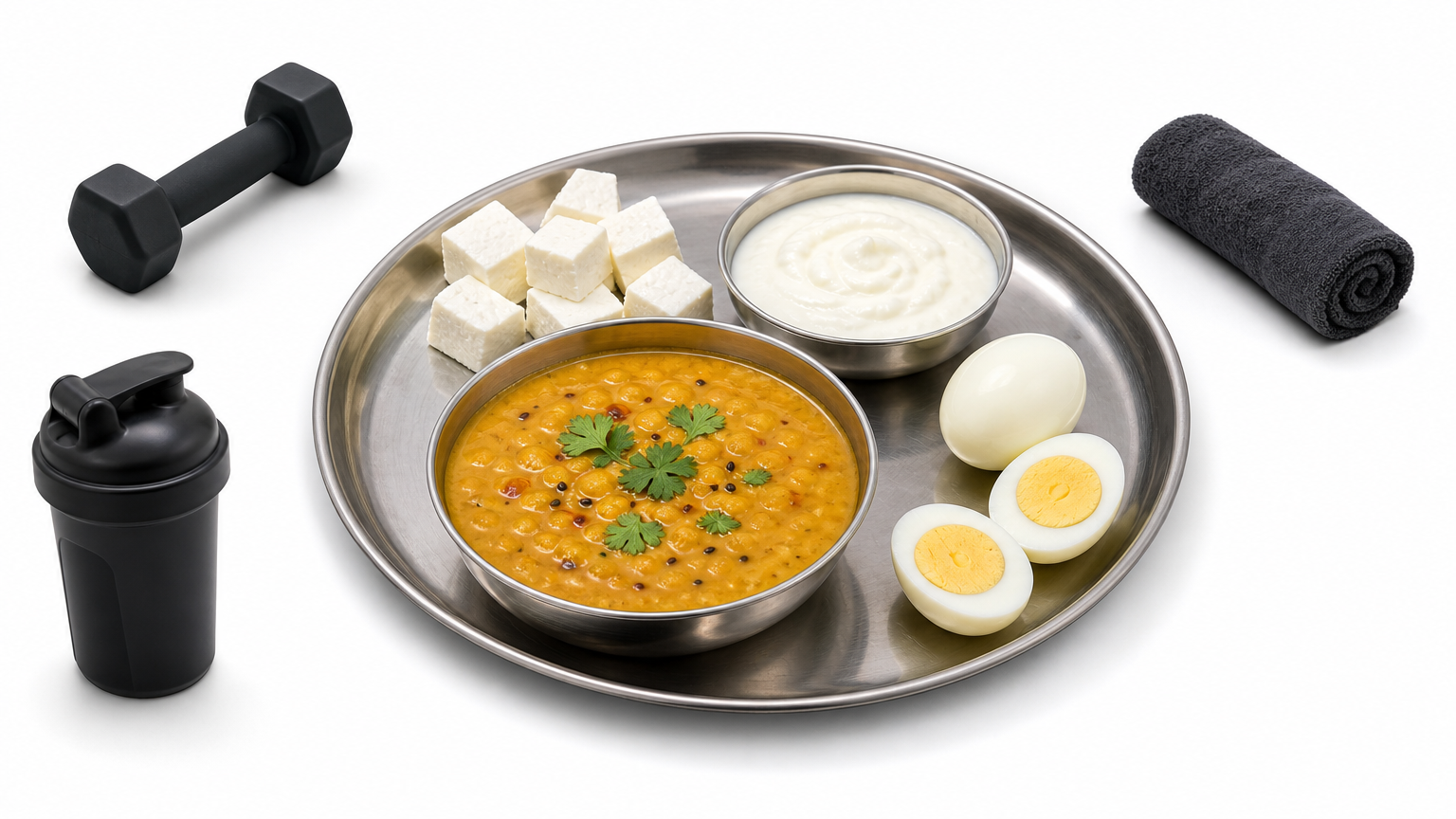
One day on these foods: 2 eggs and yogurt at breakfast (36 g), 6 oz chicken and a cup of lentils at lunch (66 g), peanuts as a snack (7 g), and a cup of lentils at dinner (18 g). That totals 127 grams, inside the 98 to 140 range. In Kolkata, fish, dal, paneer, curd, chana and soya chunks fill the same role, so check labels for the grams per serving.
Hit your protein number first, because it matters more than any supplement.
Fill in carbs and fat
Fat supports hormone function, and research on bodybuilders suggests 0.5 to 1.5 grams per kg per day. Carbohydrates take the remaining calories. For the 70 kg man on 2,700 calories:
- Protein: 112 g × 4 = 448 calories.
- Fat: 56 g (0.8 g/kg) × 9 = 504 calories.
- Carbs: (2,700 − 448 − 504) ÷ 4 = 437 g, from rice, roti, potatoes, oats and fruit.
Step 4. Recover, track and adjust
Sleep at least seven hours, keep 48 hours between sessions on the same muscles, and review three numbers every week. Muscle is built between workouts, and your log tells you what to change.
Protect sleep and rest days
Your body rebuilds muscle while you rest, so short sleep quietly caps your gains. Aim for at least seven hours, and fix your bedtime around your commute or work calls instead of squeezing training into the gap. Do not add a fourth or fifth lifting day to speed things up. Persistent fatigue, weights that drop week after week and sore joints are signs that you are doing too much.
Adding training days will not rescue a plan that has no sleep in it.
Track three numbers every week
Check the same three numbers every week, on the same day, under the same conditions:
- Body weight: the average of three or four morning weigh-ins after using the toilet.
- Waist: measured at the navel with a tape.
- Main lifts: the weight and reps from your log for squat, press and row.
Adjust when progress stalls
If your lifts and weight have both stayed flat for three weeks, add about 150 calories per day. If your waist grows quickly while your lifts barely move, you are eating more than you can use, so trim the surplus toward 300 calories. If weight rises but the lifts stall, check your sleep and how close to failure you are really training.
Your next four weeks
To build muscle, train three full-body days a week and take every set close to failure. Add load with double progression, eat a small surplus with enough protein, and protect your sleep. Then let your weekly numbers decide what to change.
Commit to this plan for four weeks, log every session, and hold your protein number. Strength gains usually show first, and visible size follows. If you want someone to check your form, plan your food around your work hours and keep you accountable, you can book a free masterclass or trial with Fit To Be Alive and talk through your goals with Raj Das.