
Mishti and weight loss: Can you really eat sweets while losing weight?
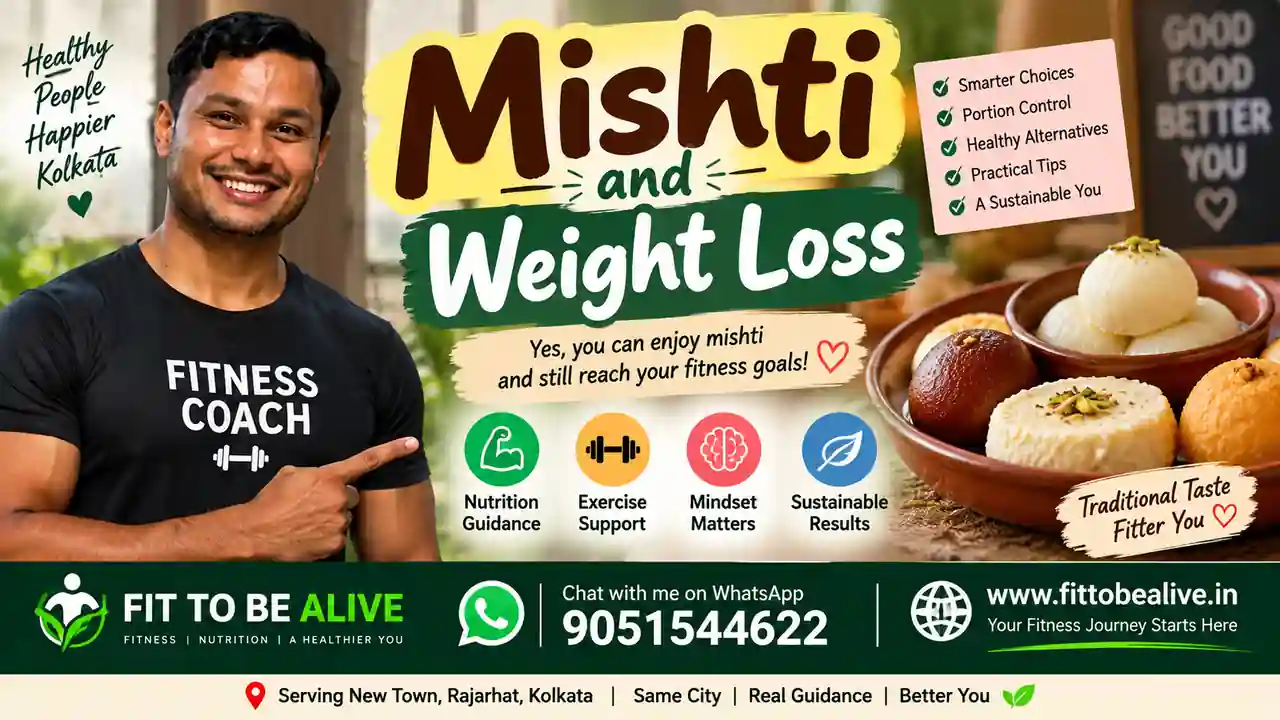
If you live in Kolkata, avoiding mishti completely can feel unrealistic. Mishti is part of celebrations, family gatherings, festivals, and even an ordinary evening when you simply want something sweet.
So, can we eat mishti during weight loss?
Yes. In most cases, you do not need to completely remove mishti to work toward fat loss. What matters more is your overall eating pattern, portion size, consistency, activity level, and whether your food intake supports your body-composition goal.
As a Certified Fitness Coach, I often see people make weight loss unnecessarily difficult. They decide that one food is “bad”, remove it completely, follow the plan for a few days, and then struggle to maintain it.
My approach is different: build a fitness lifestyle that you can actually continue.
That means understanding where mishti can fit, how much may be appropriate for you, and how to make the rest of your day support your goal.
Quick answer: Is mishti allowed during weight loss?
Mishti can be included during a weight-loss phase, but it should be treated as an occasional sweet rather than a major part of the diet.
Most traditional mishti contains some combination of sugar, dairy, flour or starch, nuts, ghee or other fats, depending on the recipe. These foods can be energy-dense, while their nutritional value varies considerably.
The practical approach is not “never eat mishti.”
It is:
Control the portion.
Avoid turning one sweet into several sweets.
Consider the rest of your day’s food intake.
Keep protein, vegetables, fruit, whole grains and other nutrient-rich foods as the foundation.
Continue your exercise and daily activity.
Focus on consistency rather than perfection.
The World Health Organization recommends keeping free sugars below 10% of total energy intake, with a further reduction toward 5% offering additional health benefits.
The 2024 Dietary Guidelines for Indians from ICMR-NIN similarly advises limiting added sugar; it describes more than 5% of daily energy, or around 25 g/day based on a 2,000-kcal diet, as high sugar intake.
These are population-level guidelines, not a personalised prescription for every individual.
Why mishti can become a problem during weight loss
The problem is usually not one piece of mishti.
The bigger issue is how frequently it is eaten, how much is eaten, and what happens around it.
For example, someone may have sweets after lunch, biscuits with tea, a sugary drink in the evening, and then dessert after dinner. Each individual choice may appear small, but together they can make it difficult to maintain the energy balance required for fat loss.
This is one reason I prefer talking about body composition and lifestyle instead of simply telling someone to “eat less.”
Your goal should not be to survive a strict diet for three weeks.
Your goal should be to develop habits that still make sense after three months, six months, and beyond.
Sugar is not the only thing to consider
When people discuss mishti and weight loss, they often focus only on sugar.
But a sweet can also contain fat and other calorie-containing ingredients. For example, preparation methods, milk products, nuts, flour, ghee and frying can all change the nutritional profile.
That is why I don’t like making blanket statements such as:
“This mishti is healthy, so you can eat unlimited amounts.”
There is no unlimited-mishti shortcut to sustainable weight loss.
Portion and overall dietary pattern still matter.
What is the best mishti for weight loss?
There isn’t one universally best mishti for weight loss.
That answer is important because traditional sweets vary significantly in ingredients, preparation, portion size and sugar content.
Instead of searching for a magical “weight-loss mishti,” look for options that allow you to control the portion and fit comfortably into your overall eating plan.
Mishti options that may be easier to portion
Depending on the preparation, you may choose a smaller portion of a simpler sweet rather than several heavily syrup-soaked or fried sweets.
For example, a small portion of a milk-based sweet can sometimes be easier to manage than eating multiple pieces of assorted sweets simply because they are available.
But don’t assume that “milk-based” automatically means low-calorie.
The actual recipe still matters.
Don’t judge a sweet by its name
“Healthy,” “homemade,” “sugar-free,” “jaggery-based,” or “protein” does not automatically mean a mishti is suitable for unlimited consumption during weight loss.
The total recipe matters.
A sweet made with jaggery is still a sweet. Replacing sugar with jaggery does not automatically turn a dessert into a low-calorie food.
ICMR-NIN specifically includes jaggery and honey among added sugars when they are added during food preparation.
Is there a mishti substitute for weight loss?
Yes, there are practical mishti substitutes for weight loss, but I prefer calling them alternatives rather than claiming that one food is a “weight-loss food.”
The best substitute is one that helps you satisfy the desire for something sweet while fitting your overall nutrition plan.
Some practical options include:
Fresh fruit with plain curd.
Unsweetened or lightly sweetened homemade yogurt with fruit.
Fruit with a small amount of nuts.
Homemade chilled curd with cardamom and fruit.
A smaller portion of your favourite traditional mishti instead of several pieces.
A homemade dessert where you control the amount of added sugar.
The purpose is not to make every dessert taste exactly like traditional Bengali mishti.
The purpose is to create an option that you can enjoy without turning a craving into an uncontrolled eating episode.
The best substitute is sometimes a smaller portion
This is something I repeatedly tell clients.
You do not always need to replace the food you love.
Sometimes you simply need to change the quantity.
If you genuinely want a piece of mishti, eating a planned portion slowly may be more satisfying than eating an “alternative” dessert you don’t actually enjoy and then searching for mishti later.
That is a practical part of sustainable behaviour.
What is a low calorie mishti for weight loss?
The phrase low calorie mishti for weight loss sounds simple, but there is an important problem: calories can vary according to recipe and serving size.
A homemade version and a shop-bought version of the same named sweet may not have the same ingredients or portion size.
So I would not publish a fixed calorie ranking of Bengali sweets unless the serving sizes and nutrition data have been specifically verified.
Instead, use this framework:
Smaller portion + controlled ingredients + less added sugar + sensible frequency = easier to fit into a weight-loss lifestyle.
Even then, the sweet is still a sweet.
It should complement your diet rather than replace nutritious meals.
A practical framework for eating mishti during weight loss
Here is the framework I would give a beginner.
Step 1: Decide whether you actually want the sweet
Don’t automatically eat mishti just because someone brought a box home.
Ask yourself:
“Do I really want this, or is it simply available?”
That small pause can change your eating behaviour.
Step 2: Choose your portion before you start
Instead of eating directly from a box, select your portion.
Put it on a plate.
Once you finish, stop and reassess.
This is much easier to manage than repeatedly opening the box and deciding “one more.”
Step 3: Don’t compensate with extreme restriction
If you eat one piece of mishti, you do not need to skip your next meal.
You also don’t need to punish yourself with excessive exercise.
Return to your normal routine.
This is where consistency becomes more important than perfection.
Step 4: Build the rest of the day around nutritious foods
Your regular meals should still provide the nutrients you need.
Think about:
Adequate protein.
Vegetables.
Fruits.
Whole grains or other quality carbohydrate sources.
Appropriate sources of dietary fat.
Adequate fluids.
A generally varied diet.
WHO recommends a varied diet and balancing energy intake with expenditure as part of a healthy eating pattern.
Step 5: Keep training
Weight loss is not only about food.
My training approach covers all five essential components of fitness, while exercises and programming are adjusted according to the person’s general fitness level and goal.
For beginners, the objective is not to destroy yourself in the gym.
The objective is to learn how to train consistently.
Healthy mishti recipe for weight loss: a simple approach
If you enjoy making food at home, a healthy mishti recipe for weight loss should focus less on finding a “magic ingredient” and more on controlling the recipe.
One simple approach is a fruit-and-curd dessert.
Simple fruit-curd dessert
Ingredients
Plain curd
Chopped seasonal fruit
Cardamom powder
A small amount of nuts, if desired
Optional small amount of added sweetness according to your overall diet
Method
Mix the curd with cardamom, add chopped fruit, and top with a small amount of nuts.
Chill before serving.
This is not traditional mishti, and I would not market it as a Bengali sweet replacement that magically causes weight loss.
It is simply a practical dessert alternative that can make it easier to include fruit and dairy while keeping added sugar under control.
If you have a specific medical condition or dietary requirement, your food choices may need individual guidance.
Can we eat mishti during weight loss and still get results?
Yes, it can be possible.
But I want to make one thing clear from my experience as a coach:
Your results will not be decided by one piece of mishti. They will be influenced by what you repeatedly do.
One of the common mistakes I see is inconsistency with the goal.
Someone follows the plan strictly for several days, then has a social event, eats sweets, feels guilty, and decides the entire plan has failed.
It hasn’t.
You simply return to your routine.
Transformation becomes much more realistic when you train your brain to think in terms of a lifestyle rather than a temporary diet.
A simple example
Suppose you attend a family function in Kolkata and have one or two sweets.
You don’t need to think:
“I have ruined my weight loss.”
Instead:
Enjoy the occasion.
Stop when your planned portion is finished.
Drink water normally.
Return to your usual meals.
Continue your next scheduled workout.
Don’t try to “burn off” the sweet as punishment.
Look at your consistency across weeks, not one meal.
That mindset is much more useful for long-term progress.
Mishti and weight loss: common mistakes to avoid
“I have to completely stop sugar”
Complete avoidance is not automatically necessary for everyone.
The more useful question is whether your overall intake and habits support your goal.
“Jaggery means I can eat more”
No.
Jaggery is still an added sugar when it is added to food.
“Sugar-free means weight-loss friendly”
Not necessarily.
A product may contain little or no added sugar while still providing substantial calories from other ingredients.
Look at the whole food, not one marketing claim.
“I ate mishti, so I should skip dinner”
This can encourage an unhealthy restrict-and-overeat cycle.
Get back to your normal routine instead.
“Exercise will cancel everything I eat”
Exercise is extremely valuable for health and fitness, but I don’t recommend treating workouts as punishment for eating.
Training should help you become fitter and stronger while supporting your overall lifestyle.
My approach as a fitness coach in New Town and Rajarhat
I am Raj Das, a Certified Fitness Coach with 2+ years of experience in the fitness industry, serving clients in and around New Town and Rajarhat, Kolkata.
My approach to weight loss is based on improving body composition and building sustainable habits rather than chasing short-term changes on the weighing scale.
I train beginners in general fitness across the five essential components of fitness and can adapt exercise selection toward a specific goal within my training scope.
One lesson I have learned from working with people is that consistency is often the real challenge.
People usually know that exercise and better food choices matter.
The difficult part is doing them repeatedly.
That’s why my coaching focuses on making the process practical.
If you are serious about your transformation, my answer is simple: yes, you can make meaningful progress when you commit to the process and build a lifestyle around your goal.
Your brain and habits have to become part of the transformation.
Who my current general-fitness training is for
My current training scope is for adults 18–55 years old who are looking for general fitness or a specific fitness goal that falls within my current training expertise.
At present, I do not provide specialised programming for special populations.
This includes people who may require specialised exercise programming, increased supervision or medical clearance, such as pregnant individuals, older adults requiring specialised programming, and people with chronic health conditions or disabilities.
I believe staying within your professional scope is part of responsible coaching.
I am continuing my education, and I plan to begin specialised training in Special Populations and Nutrition in March 2027, after completing the relevant education.
The bottom line on mishti and weight loss
You don’t necessarily have to choose between enjoying Bengali food culture and working toward your fitness goal.
Mishti and weight loss can coexist when you manage portions, frequency and your overall eating pattern.
There is no single “best mishti for weight loss,” and no sweet automatically causes fat loss.
Instead of searching for a magical low-calorie mishti, build a framework you can repeat:
Choose → portion → enjoy → stop → return to routine.
If you want a mishti substitute, use practical homemade alternatives such as fruit with curd when they genuinely satisfy you.
If you want traditional mishti, have a sensible portion and continue with your normal plan.
And remember the bigger picture: your transformation is built through repeated habits, not one dessert.
For people in New Town, Rajarhat and nearby Kolkata areas, that is the approach I want to bring to general fitness coaching: practical training, realistic habits and a sustainable body-composition goal rather than an extreme short-term diet.
