
Bengali Snacks for Weight Loss: What I Actually Recommend
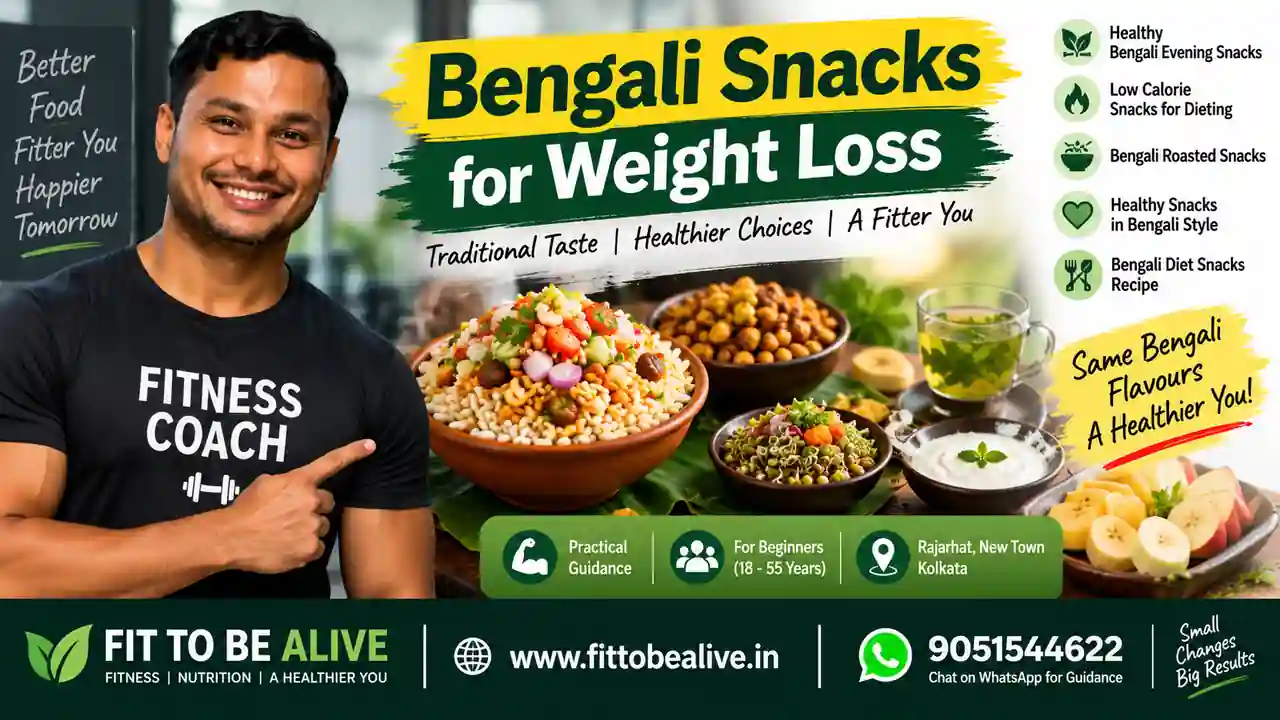
If you are trying to lose weight but do not want to give up Bengali food, you do not need to live on salads or packaged “diet snacks.”
In my experience as a certified fitness coach, the better approach is to make familiar foods work with your goal.
Bengali snacks for weight loss can include muri, chana, roasted dal, vegetables, fruit, curd and other simple homemade foods when portions, preparation methods and your overall diet are managed properly. The goal is not to find one magical snack that burns fat. The goal is to build eating habits that you can repeat consistently.
That is especially important for people in New Town, Rajarhat and Kolkata, where busy work schedules, evening tea, restaurant food and quick snacks can easily become part of everyday life.
My approach to weight loss is based on body composition and sustainable fitness, not extreme dieting. A snack should help you manage hunger and stay consistent with your overall plan—not become another complicated rule.
Quick answer: Choose snacks built around minimally processed ingredients, keep portions appropriate to your needs, limit excessive oil, sugar and salt, and pair your food choices with regular physical activity and adequate recovery.
What Makes a Bengali Snack Suitable for Weight Loss?
The word “healthy” does not automatically mean “good for weight loss.”
For example, a food can contain useful nutrients but still contribute a lot of energy if you eat a very large portion or prepare it with excessive oil.
When I help beginners understand food choices, I encourage them to think about four things:
1. The ingredients
Prefer foods such as pulses, chana, vegetables, fruits, curd, whole grains, nuts and seeds in sensible portions. ICMR-NIN’s Dietary Guidelines for Indians include whole grains, legumes, fruits, vegetables, nuts and seeds among minimally processed foods.
2. The cooking method
Steaming, boiling, roasting, dry cooking or using a controlled amount of oil can make a snack easier to fit into a calorie-controlled eating pattern than deep-frying.
That does not mean fried food is “forbidden.” It means frequency and portion matter.
3. The portion
Even a homemade snack can work against your goal if the portion becomes much larger than you need.
This is one reason I prefer teaching clients a practical framework instead of giving them a long list of foods they are “allowed” or “not allowed” to eat.
4. Your overall day
A snack does not determine whether you lose body fat.
Your overall food intake, activity, training, sleep, recovery and consistency matter much more.
WHO guidance similarly emphasizes a varied diet and balancing energy intake with expenditure rather than relying on one particular food.
Healthy Bengali Evening Snacks for Weight Loss
Evening is where many people struggle.
You come home from work hungry, make tea, see biscuits or singara in front of you, and suddenly your planned dinner is no longer the only food you are eating.
Instead of trying to eliminate evening snacks completely, build a better default.
Here are some healthy Bengali evening snacks for weight loss that can be adapted to your routine.
Muri with vegetables and chana
Muri can be a practical Bengali snack when you control the additions.
Try combining a moderate portion of muri with chopped cucumber, tomato, onion, coriander, green chilli if you tolerate it, and some boiled chana.
The important point is not to turn it into a huge bowl loaded with oil, chanachur or other calorie-dense additions.
Chola or boiled chana
Boiled chana is a simple option when you want something more substantial than tea and biscuits.
Add onion, cucumber, tomato, coriander, lemon and spices according to your preference.
For a weight-loss plan, think about the complete portion rather than assuming that unlimited amounts are appropriate simply because the food is homemade.
Roasted chana
Roasted chana can be convenient for work or travel.
It also fits naturally into the idea of Bengali roasted snacks for weight loss, particularly when you choose a relatively simple preparation rather than a heavily salted or oil-coated packaged snack.
Keep the portion ready in advance instead of repeatedly eating directly from a large packet.
Homemade roasted dal
Roasted dal can also work as a crunchy alternative to fried snacks.
The advantage of preparing it yourself is that you have more control over oil and salt.
That control matters because healthy eating is not only about calories. WHO recommends limiting excessive salt, free sugars and unhealthy fats as part of a healthy dietary pattern.
Fruit with plain curd
If you prefer something lighter or slightly sweet in the evening, fruit with plain curd can be a practical combination.
Choose the fruit and portion according to your overall meal plan.
I generally prefer this type of simple food to turning every evening snack into a “diet recipe” requiring expensive ingredients.
Low Calorie Bengali Snacks for Dieting: How to Think About Them
People often search for low calorie Bengali snacks for dieting, but there is a problem with focusing only on the phrase “low calorie.”
The lowest-calorie food is not automatically the most useful snack.
If a snack leaves you hungry 20 minutes later, you may simply eat another snack.
Instead, ask:
Does this snack fit my daily food intake?
Does the portion satisfy me?
Does it contain a useful source of protein, fibre or other nutrients?
Can I prepare it regularly?
Will I still enjoy it after several weeks?
Does it help me stay consistent?
This is where sustainable weight management becomes different from a short-term crash diet.
Bengali Roasted Snacks for Weight Loss: My Practical Framework
If you enjoy crunchy snacks, you do not necessarily need to remove them from your life.
Use this simple framework:
Choose the base
Examples include roasted chana, roasted dal or another minimally processed ingredient.
Add flavour without turning it into a calorie bomb
Use lemon, coriander, chilli, cumin, black pepper or other spices you enjoy.
Control oil
Oil is energy-dense, so “just a little extra” can add up.
You do not need to eliminate dietary fat, but the amount used in preparation should fit your overall eating pattern.
Watch the packaged versions
Some products marketed as “roasted,” “healthy” or “fitness snacks” can still contain considerable amounts of salt, added fat or other ingredients.
The word roasted does not automatically make a product suitable for every weight-loss plan.
Healthy Snacks in Bengali Style: You Don’t Need Special Diet Food
One of the biggest mistakes I see beginners make is believing that weight loss requires completely different food.
It often does not.
You can build healthy snacks in Bengali style around the foods you already understand.
Think:
Traditional food → smarter preparation → sensible portion → consistent routine.
That is much easier to maintain than suddenly switching to imported “fitness foods” that you do not enjoy.
For someone living in Rajarhat or New Town, this can be especially practical. Your food choices need to fit your actual life—your office schedule, commute, family meals, social occasions and training routine.
Bengali Diet Snacks Recipe: A Simple Muri-Chana Bowl
If you want a quick Bengali diet snacks recipe, start with something simple rather than complicated.
Ingredients
Muri
Boiled chana
Cucumber
Tomato
Onion
Coriander
Lemon juice
Green chilli, optional
Roasted cumin or other spices
Salt in a controlled amount
Method
Mix the ingredients shortly before eating so the muri remains reasonably crisp.
Adjust the quantity of muri and chana according to your overall meal plan and hunger.
There is no universal “perfect” quantity because calorie and nutrient requirements differ between individuals.
What About Singara, Beguni and Telebhaja?
This is where I want to be practical.
You do not have to tell yourself that Bengali fried foods will never be allowed again.
But if your everyday evening routine is two singaras + sweet tea + biscuits, changing the frequency and portion can make a meaningful difference to your overall eating pattern.
Deep-fried foods can be energy-dense, and frequently eating foods high in unhealthy fats, salt or added sugars can make a healthy eating pattern more difficult. WHO recommends limiting foods high in unhealthy fats, free sugars and sodium.
So instead of asking:
“Can I eat singara while losing weight?”
Ask:
“How often can I include it while still maintaining the eating pattern required for my goal?”
That is a much more useful question.
How I Combine Snacks With Fitness
Food is only one part of transformation.
As a certified fitness coach, I train beginners around the five essential components of fitness and also adapt general fitness training to an individual’s specific goal.
For someone working toward better body composition, I do not want their entire strategy to be:
“Eat less.”
We need to consider training, movement, recovery, consistency and lifestyle.
A practical fitness lifestyle is something you can continue after the first few weeks of motivation disappear.
The consistency problem
One of the common mistakes I see is starting with an extremely strict goal and then losing consistency.
Someone may follow a perfect diet for five days, have one social meal, feel that they have failed, and then abandon the entire plan.
I would rather see a person follow a realistic approach consistently and learn how to handle Bengali food, family occasions, eating outside and busy workdays.
Can Bengali Snacks Help With Body-Composition Goals?
They can be part of the plan, but no Bengali snack independently causes fat loss.
Body-composition change requires looking at the bigger picture.
Your food intake, physical activity, resistance training, daily movement, recovery and consistency all interact.
A healthy dietary pattern should also provide variety rather than focusing narrowly on one “weight-loss food.” WHO recommends a varied diet containing foods such as vegetables, fruits, legumes, nuts and whole grains while limiting excessive free sugars, salt and unhealthy fats.
That is why my recommendation is simple:
Don’t build your weight-loss plan around one snack. Build it around a lifestyle you can repeat.
My Practical Bengali Snack Framework for Beginners
When you are hungry between meals, use this five-step check:
Step 1: Check your hunger
Are you genuinely hungry, or are you eating because tea time has arrived?
Step 2: Choose a simple food
Start with foods you can recognize and prepare without a complicated recipe.
Step 3: Include a satisfying component
Depending on your needs, this may include chana, curd, pulses, nuts or another appropriate protein-containing food.
Step 4: Control the extras
Oil, sugar, salty mixtures, sauces and oversized portions can change the overall nutritional profile of a snack.
Step 5: Return to normal
If you occasionally eat a less nutritious snack, do not turn one meal into an entire weekend of overeating.
Get back to your normal routine.
Who Should Use This General Approach?
This article is written for generally healthy adults looking for practical Bengali food ideas to support a fitness or weight-management lifestyle.
My current general-fitness coaching boundary is adults aged 18–55, for both men and women.
I currently do not provide specialised training or nutrition programming for special populations. This includes people who may require customised programming, increased supervision or medical clearance, such as older adults, pregnant individuals and people with chronic health conditions or disabilities.
If you have a medical condition, take medication that affects nutrition or exercise, are pregnant, or have another condition requiring individualised care, speak with an appropriately qualified healthcare professional before making major changes to your diet or exercise routine.
I plan to expand my education in special-population training and nutrition from March 2027 after completing the relevant education.
My Approach as a Certified Fitness Coach in New Town and Rajarhat
I am Raj Das, a Certified Fitness Coach with 2+ years of experience in the fitness industry.
My job is not to make your fitness journey unnecessarily complicated.
I work with beginners in general fitness and use the five essential components of fitness as part of my training approach. When a client has a specific goal within my scope, I adapt the training accordingly.
One thing I have repeatedly seen is that transformation becomes much easier when the brain and lifestyle are trained alongside the body.
You do not need to be perfect.
You need a system that you can actually follow.
If you are serious about your transformation, yes, you can make progress—and my role is to help make that journey more practical, structured and easier to follow.
For people around New Town, Rajarhat and Kolkata, that means building fitness around real life rather than pretending everyone has the same schedule, food preferences or experience.
Frequently Asked Questions About Bengali Snacks for Weight Loss
What are the best Bengali snacks for weight loss?
There is no single best snack for everyone. Practical options can include moderate portions of muri with vegetables and chana, boiled chana, roasted chana, roasted dal, fruit with plain curd and other minimally processed homemade snacks.
Can I eat muri while trying to lose weight?
Yes, muri can be included in a weight-management diet. The important factors are portion size and what you add to it. A large serving with lots of oil or calorie-dense mixtures can be very different from a moderate serving combined with vegetables and chana.
Are roasted snacks better than fried snacks?
Roasting can reduce the need for added frying oil, but “roasted” does not automatically mean low-calorie or healthy. Check the ingredients, added fat, salt and portion.
What should I eat with evening tea?
Instead of automatically reaching for biscuits or fried snacks, you can consider options such as roasted chana, boiled chana, fruit, plain curd or a simple homemade snack that fits your overall plan.
Can I eat Bengali food and still lose body fat?
Yes, Bengali food does not automatically prevent fat loss. Your overall dietary pattern, energy intake, physical activity and consistency matter. Traditional foods can often be adapted through portions and preparation methods.
Do I need to completely stop sweets and fried food?
Not necessarily. Whether and how often you include them should depend on your overall goals and eating pattern. For many people, managing frequency and portion is more sustainable than creating an unrealistic list of permanent prohibitions.
Final Takeaway
Bengali snacks for weight loss do not need to be boring, expensive or completely different from the food you already enjoy.
Start with simple Bengali ingredients. Control portions. Reduce unnecessary frying, added sugar and excessive salt. Include nutritious foods such as vegetables, fruits, pulses, whole grains, nuts, seeds and appropriate protein sources across your overall diet.
Most importantly, stop looking for one food that will transform your body.
Your transformation comes from the combination of nutrition, training, movement, recovery and consistency.
As a fitness coach serving New Town, Rajarhat and Kolkata, my aim is to help beginners turn fitness into a lifestyle they can actually maintain.
If you are ready to take your general fitness seriously, start with a realistic plan—and then keep showing up.
