
High Protein Bengali Foods: A Practical Guide for Muscle Building and Everyday Fitness
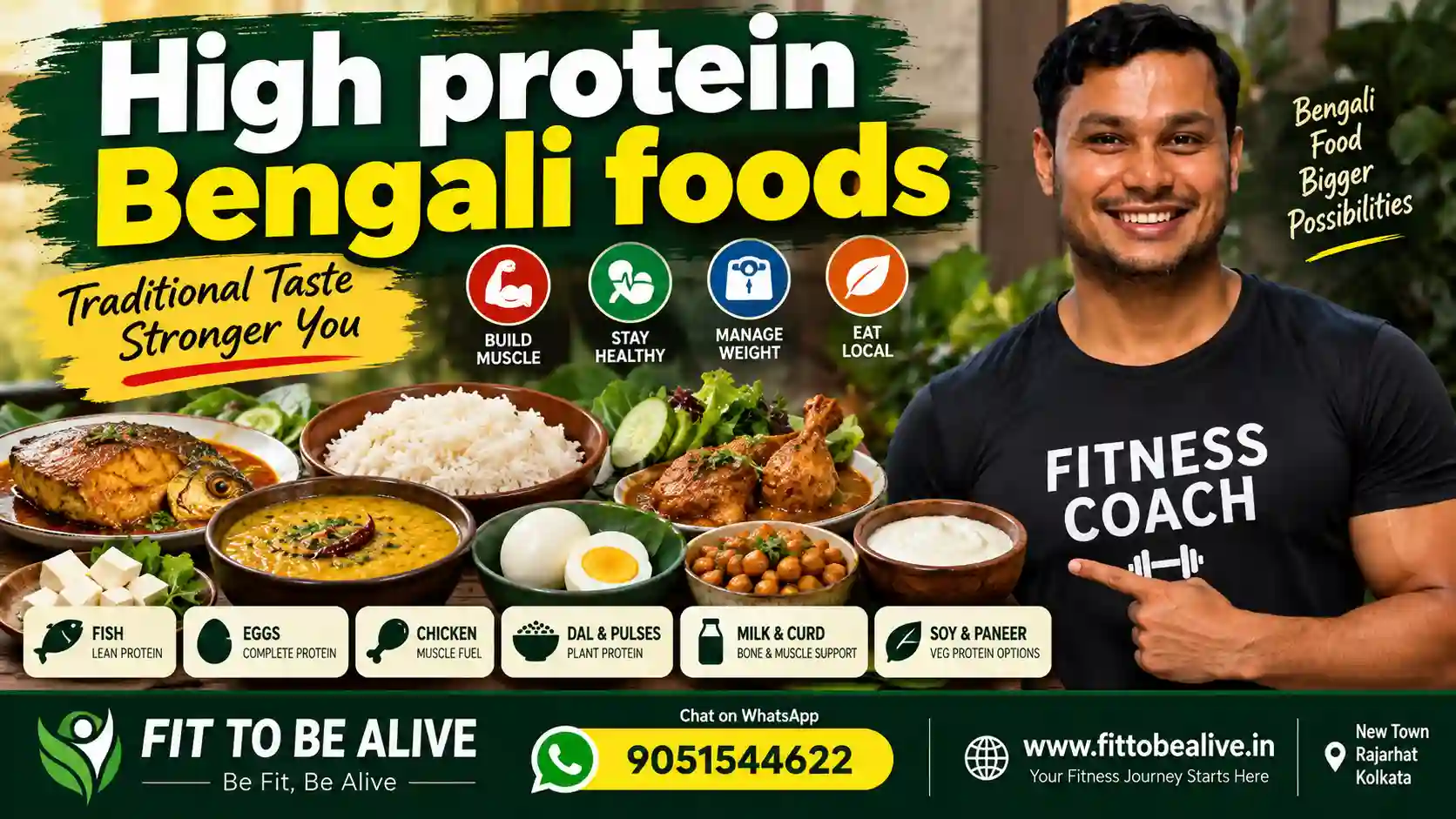
If you love Bengali food but think you need to give up your traditional meals to eat more protein, you don’t.
In my experience as a certified fitness coach, one of the biggest problems beginners face is not a lack of motivation. It is making fitness unnecessarily complicated. People start searching for expensive supplements, imported foods and complicated meal plans while overlooking the protein-rich foods that are already part of a Bengali kitchen.
This is exactly why I created this practical guide to high protein Bengali foods.
Whether your goal is building muscle, improving body composition, losing excess body fat or simply eating a more balanced diet, Bengali food can absolutely fit into your routine.
I am Raj Das, a Certified Fitness Coach with 2+ years of experience in the fitness industry. I work with beginners and general-fitness clients, including people in New Town, Rajarhat and the surrounding Kolkata area. My approach is practical: build a fitness lifestyle that you can actually maintain instead of following a plan that works only for a few weeks.
Quick summary: the best high protein Bengali foods
For a Bengali-style high-protein diet, build your meals around foods such as:
Fish such as rohu, katla and other commonly available varieties
Eggs
Chicken
Milk and curd
Dal and other pulses
Chana and chickpeas
Soy-based foods
Paneer, when it fits your calorie and fat requirements
Peanuts and selected nuts or seeds
Rice or roti paired with dal, fish, eggs or another protein source
The key is not finding one magical “best” protein food. It is consistently building meals where a meaningful protein source is present.
ICMR-NIN’s Dietary Guidelines for Indians 2024 give a protein RDA of 0.83 g/kg/day for healthy adults. Actual requirements can differ depending on factors such as training, body size, goals and individual circumstances, so a generic number should not automatically be treated as a personalised bodybuilding prescription.
Why Bengali food can work for a high-protein diet
Traditional Bengali meals often get described mainly through rice, fish, vegetables and dal. But that combination can be structured differently depending on your goal.
The easiest way to think about your plate is:
Protein source + vegetables + sensible carbohydrate portion + appropriate amount of cooking oil
For example, instead of thinking:
“Rice is bad for fitness.”
Think:
“How can I build my rice meal around enough protein and vegetables?”
A meal of rice, dal, fish and vegetables can be completely different from a meal dominated by a large portion of rice with only a small amount of protein.
This distinction matters.
For someone trying to improve body composition, the overall eating pattern, food quantity, protein intake, training, sleep and consistency matter much more than declaring one traditional Bengali food “good” or “bad.”
High protein Bengali foods you can actually use
Fish: the Bengali protein staple
Fish is one of the easiest ways for a Bengali household to increase protein without abandoning familiar food.
Rohu, katla and other locally available fish can be included in regular meals. The exact protein content varies according to the fish, edible portion and preparation method, so avoid assuming that every piece of fish provides exactly the same amount of protein.
For fitness, the practical lesson is simple: use a reasonable serving of fish as the central protein source of your meal.
Cooking method also matters. A lightly cooked jhol or similar preparation can be easier to fit into a calorie-controlled diet than a preparation involving large amounts of oil.
Eggs
Eggs are convenient, affordable and easy to prepare.
You can use boiled eggs, omelettes or eggs incorporated into a Bengali-style meal. If you’re managing calories, the total amount of egg and the rest of the meal should be considered together rather than treating eggs as either completely unrestricted or completely off-limits.
For a beginner, eggs are one of the easiest foods to keep available at home.
Chicken
Chicken is another practical protein option, especially for people who want a higher-protein meal while controlling overall calories.
The preparation makes a difference. A simple chicken curry with a sensible amount of oil can fit into a fitness-oriented diet. Deep-fried chicken preparations are a different nutritional proposition.
The goal is not to remove Bengali flavours. It is to manage the preparation and portion.
Dal
Dal is important in a Bengali diet and can contribute meaningful protein.
However, I would not treat dal as the only protein source for someone specifically trying to increase protein intake.
A much more practical approach is to combine dal with other foods.
For example:
Rice + dal + fish + vegetables
or
Roti + dal + eggs + vegetables
ICMR-NIN notes that combining cereals and pulses can improve the overall amino-acid profile of a plant-based meal because their amino-acid limitations complement each other.
Chana and chickpeas
Chana and chickpeas can be useful vegetarian protein sources.
You can use them in salads, curries or simple snacks. They also make it easier to add variety when you don’t want every protein meal to be based on fish or eggs.
Remember that pulses and legumes also provide carbohydrates and calories, so portion size still matters when your goal is fat loss.
Milk and curd
Milk and curd can contribute protein while also fitting naturally into many Indian eating patterns.
Curd can be particularly useful as part of lunch or dinner, while milk can be included according to your personal preference and calorie requirements.
If you’re choosing packaged products, check the nutrition label rather than relying only on marketing terms such as “high protein.”
Soy-based foods
Soy foods can be particularly useful for people following a vegetarian diet.
They provide a way to increase protein without depending entirely on dairy.
If you are building a Veg Bengali high protein diet plan, soy, dal, chana, milk/curd and other suitable protein sources can be rotated throughout the week.
High protein Bengali dishes that are practical for fitness
The best meal is not necessarily the most complicated one.
Here are some practical combinations:
Fish jhol with rice and vegetables
A simple fish jhol with a sensible rice portion and plenty of vegetables can become a balanced everyday meal.
You don’t need to remove rice simply because you are exercising.
Egg curry with roti or rice
Egg curry can be a convenient option for breakfast, lunch or dinner depending on your routine.
Keep the cooking oil reasonable and make sure the meal contains enough protein rather than relying on a very small egg portion.
Dal with eggs and vegetables
This is an inexpensive combination for beginners.
Dal provides protein and carbohydrates, while eggs increase the protein contribution of the meal.
Chicken Bengali-style curry
Use chicken as the main protein, add vegetables where appropriate and control the amount of oil.
This can work well for people who enjoy traditional Bengali flavours but are trying to improve their body composition.
Chana or chickpea preparation
A chickpea-based meal can work particularly well for vegetarian clients when combined with other suitable protein foods throughout the day.
Healthy Bengali fish recipes for bodybuilding
If you’re looking for healthy Bengali fish recipes for bodybuilding, don’t focus only on the recipe name.
Focus on four things:
How much fish you are actually eating
How much oil is used
What carbohydrate portion accompanies the fish
Whether the rest of the day provides enough protein
Fish jhol, lightly spiced fish curry and simple steamed or pan-cooked fish can all be adapted to a fitness-oriented diet.
The biggest mistake is believing that a “healthy recipe” automatically produces a muscle-building diet.
Your entire day’s food matters.
A person can eat a healthy fish curry and still have a poorly structured diet if total protein is inadequate, meals are inconsistent or overall food intake does not match the goal.
A simple Veg Bengali high protein diet plan framework
A vegetarian Bengali diet can also be structured around protein.
Instead of copying a rigid seven-day menu, use this framework:
Breakfast
Choose one main protein source:
Eggs, if you eat them
Milk or curd
Chana
Soy-based food
Add a suitable carbohydrate and fruit or vegetables according to your needs.
Lunch
Build the meal around:
Rice or roti + dal + a stronger vegetarian protein source + vegetables + curd
The important point is not to make rice the entire meal.
Evening snack
Choose something practical such as:
Chana
Curd
Milk
Eggs
A suitable homemade snack containing a protein source
Dinner
Use a similar structure:
Protein source + vegetables + controlled carbohydrate portion
The exact quantities should depend on your body size, activity, goals and total daily intake.
Bengali food for muscle building: what actually matters
Food supports muscle development, but food alone does not create muscle.
Resistance training provides the stimulus. Adequate nutrition supports recovery and adaptation.
This is why I always tell beginners not to obsess over individual foods.
If someone eats a high-protein diet but trains inconsistently, sleeps poorly and changes their plan every week, the diet is not going to solve the underlying problem.
I have seen this repeatedly with beginners: the common mistake is inconsistency with the goal.
A sustainable fitness lifestyle is more useful than a perfect plan followed for ten days.
How I would structure a Bengali fitness plate
A simple framework is:
1. Start with protein
Fish, eggs, chicken, dal, chana, soy, curd, milk or another suitable source.
2. Add vegetables
Use seasonal vegetables and traditional Bengali preparations where practical.
3. Add carbohydrates according to your goal
Rice, roti, potatoes and other carbohydrate foods can fit into a fitness diet. The amount should reflect your total energy needs and activity.
4. Control cooking oil
You don’t have to eliminate oil. You need to account for it.
5. Repeat consistently
A good meal eaten consistently is more useful than a theoretically perfect meal that you cannot maintain.
What I tell clients who ask, “Will I get results?”
My answer is straightforward:
If you are serious about your transformation, you can make progress.
But I don’t promise a particular result or timeline to everyone.
Your starting point, training consistency, food intake, sleep, stress, lifestyle and ability to follow the plan all matter.
In my coaching experience, transformation becomes much easier when the brain is trained to think of fitness as a lifestyle rather than a temporary challenge.
You don’t need to be perfect.
You need to become consistent.
Common mistakes when eating for muscle building
Removing rice completely
Rice is not automatically the reason someone gains body fat.
The overall quantity and composition of the diet matter.
Eating protein only at dinner
Try to distribute protein-containing foods across the day instead of leaving most of your protein intake for one meal.
Depending entirely on supplements
Protein powder can be convenient for some people, but it is not compulsory for everyone. Regular foods can provide protein too.
Eating “healthy” but ignoring portions
Nuts, paneer, oil and other nutritious foods can still contribute substantial calories.
Healthy does not automatically mean unlimited.
Changing the plan every week
This is one of the biggest beginner problems I see.
Give your routine enough time to become a habit and assess progress systematically.
Who this approach is for
My general fitness coaching is designed for adults aged 18–55, both men and women.
I work with beginners across the essential components of fitness and use exercises appropriate for general fitness. If someone has a specific fitness goal, I can structure training around that goal within my scope of practice.
My local service area includes New Town, Rajarhat and Kolkata.
My approach to weight loss focuses on body composition and sustainable habits, rather than extreme short-term dieting.
Who should seek specialist guidance first
There are situations where a general fitness approach is not enough.
Special populations can include people with chronic health conditions, disabilities, pregnancy, older adults and others who require individually modified programming, greater supervision or medical clearance.
At present, I do not provide specialised training for these populations.
I am continuing my education in this area and plan to begin Special Populations training and Nutrition education in March 2027.
If you have a medical condition or another situation requiring specialised exercise or nutrition support, work with an appropriately qualified healthcare or specialist professional.
Frequently asked questions about high protein Bengali foods
What are the best high protein Bengali foods?
Fish, eggs, chicken, dal, chana, soy-based foods, milk and curd are practical options. The right combination depends on whether you eat vegetarian or non-vegetarian foods and on your overall fitness goal.
Can I eat rice while trying to build muscle?
Yes. Rice can be part of a muscle-building or fitness diet. The important question is how much you eat and what you eat with it. Pairing rice with a meaningful protein source and vegetables is generally more useful than treating rice as the entire meal.
Which is the best protein source in Bengali food?
There is no single best choice for everyone. Fish, eggs, chicken, dairy, pulses, chana and soy can all play different roles. Variety makes the diet easier to maintain.
Can Bengali food help with muscle building?
Yes, provided the overall diet supplies sufficient energy and protein and you follow an appropriate resistance-training programme. Bengali cuisine does not need to be abandoned to pursue fitness.
Can vegetarians follow a high-protein Bengali diet?
Yes. A vegetarian plan can use dal, chana, soy foods, dairy and other suitable protein sources. Combining different plant foods can also improve the overall amino-acid profile of meals.
Do I need protein powder?
Not necessarily. Protein supplements are a convenience, not a requirement. Your daily diet can contain protein from regular foods.
How much protein should I eat?
ICMR-NIN’s 2024 Dietary Guidelines list an RDA of 0.83 g/kg/day for healthy adults. People who train regularly or have specific body-composition goals may require individual planning rather than simply applying the general population RDA.
Can these foods help with weight loss?
They can be included in a weight-loss diet, but no individual food causes fat loss by itself. For sustainable weight management, I focus on body composition, appropriate food portions, resistance training, physical activity and consistency.
My practical framework for eating Bengali food and staying fit
You don’t have to choose between Bengali food and fitness.
Use this simple framework:
Protein first → vegetables next → appropriate carbohydrates → control cooking oil → train consistently → sleep well → repeat.
That is the approach I prefer over extreme diets.
If you live in New Town, Rajarhat or Kolkata and you’re a beginner looking to improve your general fitness, build better habits, lose excess body fat or work towards a specific fitness goal, the first step is to understand where you are starting from.
Your transformation does not need to begin with a perfect diet.
It begins with a routine you can actually follow.
Fit to Be Alive — Be Fit, Be Alive.
Nutrition note: This article is intended as general educational information and is not a substitute for individual medical or clinical nutrition advice. Food composition varies with ingredient, serving size and preparation method. People with medical conditions or specialised dietary requirements should seek appropriate professional guidance.
