
Weight Loss for Night Shift Workers: A Practical Framework That Fits Your Schedule
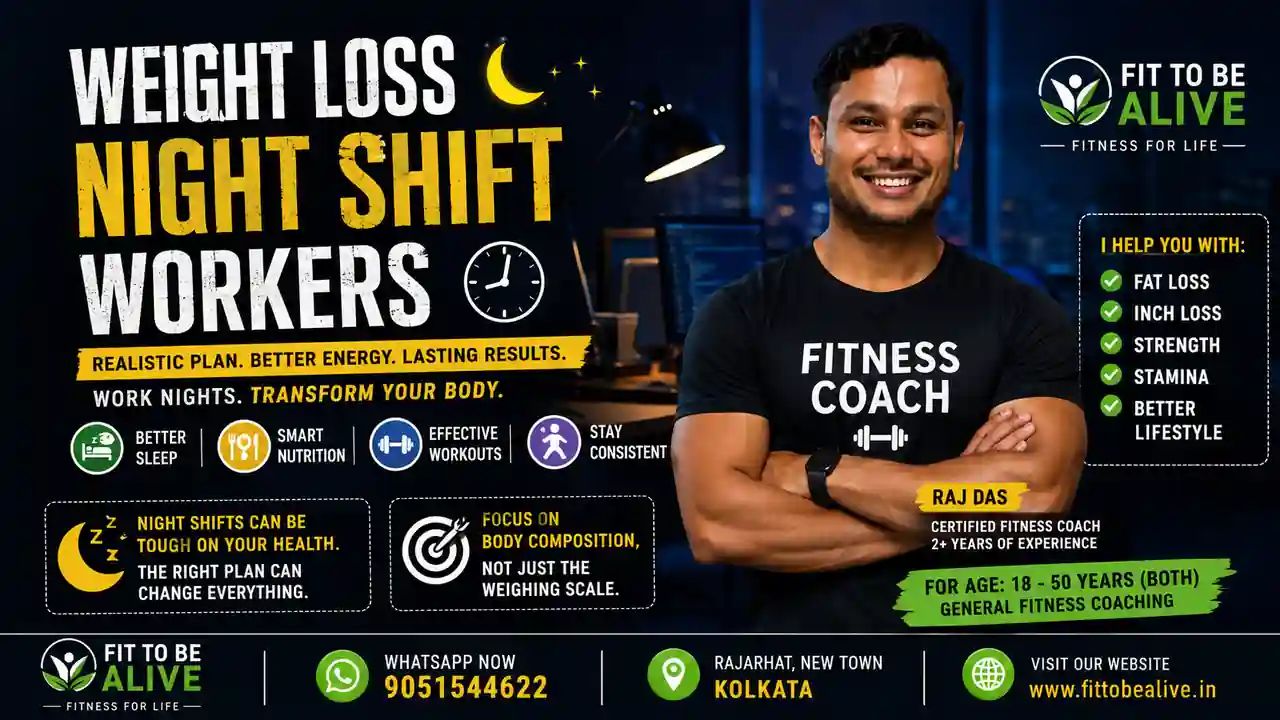
Short answer: Weight loss for night shift workers is possible, but the strategy has to fit the reality of working at night. Instead of trying to follow a traditional daytime diet and workout routine, build your plan around four things: consistent eating habits, sufficient sleep, regular exercise, and sustainable body-composition goals. Night work can make sleep, meal timing, food choices and consistency more difficult, so the goal is not perfection. The goal is to build a routine you can repeat.Weight loss night shift workers
If you work night shifts in Rajarhat, New Town, Kolkata, you may already know the problem. Your workday starts when everyone else is preparing for bed. Your biggest meal may happen at an unusual time. You may feel tired after work, sleep during the day and struggle to find the motivation to exercise.
That does not mean you cannot transform your body.
I am Raj Das, a Certified Fitness Coach with 2+ years of experience in the fitness industry, and I work with beginners and general-fitness clients in the Rajarhat and New Town area. My approach is practical: instead of chasing extreme diets or short-term transformations, I focus on building fitness habits that can become part of your lifestyle.
For weight loss, I focus on body composition and sustainable progress, not simply making the number on the weighing scale fall. Weight loss night shift workers.
Why Weight Loss Can Feel Harder During Night Shifts
Night-shift work creates a different environment for managing your health.
Research has found associations between shift work and higher BMI or body-weight outcomes, although the relationship is complex and does not mean every night-shift worker will gain weight. A 2024 meta-analysis covering 63 studies and more than 693,000 participants found a small but statistically significant association between shift work and BMI.
The challenge is not simply that you are awake at night.
Your routine may also involve:
-
Irregular meal times
-
Frequent snacking during long shifts
-
Reliance on convenient foods
-
Less physical activity when you are tired
-
Poor or shortened daytime sleep
-
Multiple cups of caffeine
-
Social routines that interfere with recovery
-
Difficulty maintaining the same routine on workdays and days off
A systematic review of rotational shift work found patterns including more irregular and frequent meals, increased night eating and snacking, and greater consumption of discretionary foods.
That is why I don’t recommend simply telling a night-shift worker, “Eat less and exercise more.”
The plan has to address the whole routine.
My Framework for Weight Loss for Night Shift Workers
I use a simple framework:
Sleep → Food → Training → Daily Movement → Consistency
Think of these as connected parts rather than separate tasks.
If your sleep is poor, training can feel harder.
If your meals are completely unplanned, your food choices can become reactive.
If your workouts are unrealistic, you eventually stop doing them.
And if the plan cannot survive your actual work schedule, it is not a sustainable plan.
Step 1: Build Your Sleep Routine First
Sleep is not something I would treat as an optional extra.
Adults aged 18–60 are generally recommended to get at least seven hours of sleep per day. Night-shift workers can have particular difficulty getting sufficient, good-quality sleep because they are trying to sleep during the daytime.
NIOSH guidance for night workers recommends going to bed soon after returning home, sleeping as long as possible, and using naps when appropriate. A dark, quiet sleeping environment can also help.
A practical routine might look like this:
After your shift
Finish work → go home → keep unnecessary activities short → have a suitable meal or snack if hungry → prepare your room → sleep.
Don’t automatically use the morning after your shift for shopping, scrolling, household chores and social activities if that means sacrificing your main sleep period.
Make daytime sleep easier
Try to make your bedroom:
-
Dark
-
Quiet
-
Comfortable
-
Cool enough for you
-
Free from unnecessary interruptions
Tell family members or people you live with that your daytime sleep is your recovery time.
Step 2: Stop Treating Night-Shift Eating as a Free-for-All
You do not need to panic because you ate at 2 a.m.
Your entire daily or weekly pattern matters much more than one clock time.
However, night-shift workers often face irregular eating and more night-time snacking, so having a plan can make a major difference.
Instead of asking:
“What am I allowed to eat at night?”
Ask:
“What food will help me stay satisfied and still fit my overall goal?”
A simple night-shift meal structure
Build most meals around:
-
A protein source
-
Vegetables or fruit
-
A sensible carbohydrate source
-
A suitable amount of dietary fat
-
Water and other appropriate fluids
For example, depending on your preferences and overall nutritional needs:
Meal 1: Eggs/paneer/curd + roti or another carbohydrate source + vegetables
Meal 2: Rice/roti + dal + chicken/fish/paneer + vegetables
Shift snack: Fruit + curd, or another convenient protein-containing option
After-shift meal: A moderate meal based on hunger and your next sleep period
The exact foods do not need to be identical for everyone.
The important part is creating a pattern that prevents every meal from becoming an emergency food decision.
What about eating during the night?
There is growing research into meal timing and night eating in shift workers, but the evidence is not strong enough to claim that one universal eating window is the best solution for everyone.
Recent reviews suggest that meal-timing interventions may have potential, but current clinical evidence in shift workers remains limited.
So I would not tell every client:
“Never eat after midnight.”
That is too simplistic.
Instead, we can look at your complete schedule, hunger, training, sleep and food intake and create a routine you can actually follow.
Step 3: Use Exercise to Build Fitness, Not Just Burn Calories
Exercise is an important part of a weight-loss plan, but I don’t want clients to think that exercise is punishment for eating.
My training approach works across the major health-related components of fitness:
-
Cardiorespiratory fitness
-
Muscular fitness
-
Body composition
-
Flexibility
-
Neuromotor fitness
ACSM’s current framework describes muscular fitness as including strength, endurance and power.
For a beginner, this does not mean complicated workouts.
It can mean learning how to perform basic movements safely and progressively.
Exercises I may use with general-fitness beginners
Depending on the person’s ability and goal, training can include movements such as:
-
Squats or appropriate squat variations
-
Hip-hinge movements
-
Push-up variations
-
Rowing or pulling movements
-
Lunges or split-stance exercises
-
Core exercises
-
Walking
-
Basic cardiovascular conditioning
-
Mobility and flexibility work
The exercise selection should match the individual rather than forcing everyone into the same program.
For general health, WHO recommends adults accumulate at least 150 minutes of moderate-intensity physical activity per week, or 75 minutes of vigorous activity, with muscle-strengthening activity involving major muscle groups on at least two days per week.
But if you currently do almost nothing, don’t start by trying to become an athlete.
Start with something you can repeat.
Step 4: Train Around Your Shift, Not Against It
This is one of the biggest practical lessons for night-shift workers.
There is no universal “best” workout time.
If you finish your shift at 6 a.m. and are exhausted, forcing yourself into a hard workout immediately before bed may not be the smartest choice.
Another person may prefer training after waking in the afternoon.
Someone else may have a day off when they can train for longer.
Your schedule should determine the practical training window.
A simple example
If your shift is approximately 10 p.m. to 6 a.m.:
6:30–7:30 a.m.
Return home and prepare for sleep.
7:30 a.m.–2:30 p.m.
Main sleep period.
3:00 p.m.
Wake, hydrate and have your first meal.
4:00–5:00 p.m.
Training, if this fits your energy and schedule.
5:30 p.m.
Main meal.
9:00 p.m.
Meal/snack before work, depending on hunger and your overall plan.
During shift
Planned meal/snack rather than uncontrolled grazing.
This is only an example, not a prescription.
Your actual schedule, commute, sleep needs, family responsibilities and work pattern should determine your routine.
Step 5: Don’t Ignore Daily Movement
A gym session is only one part of your day.
If your job and commute mean you spend most of the remaining time sitting, look for simple opportunities to increase movement.
For example:
-
Walk during suitable breaks
-
Take stairs when practical
-
Walk short distances instead of always using transport
-
Add a short walk after waking
-
Use active recovery on non-training days
You do not need to turn every day into a workout.
The goal is to make movement normal.
The Biggest Mistake I See: Inconsistency
One of the common mistakes I see is not a lack of information.
People already know many basics.
The bigger problem is inconsistency.
Someone follows a strict diet for five days, has an exhausting shift, sleeps badly, misses training, orders food and then decides the entire plan has failed.
I prefer a different mindset.
One difficult day does not destroy your transformation.
The next decision matters.
If you miss a workout, return to your next planned session.
If one meal is higher in calories than planned, continue normally instead of starving yourself the next day.
If your sleep schedule gets disrupted, rebuild it rather than abandoning the entire routine.
Your goal is to create a fitness lifestyle, not complete a 14-day challenge.
Body Composition Instead of Obsessing Over the Scale
Weight loss is often presented as a single number.
I prefer to think about body composition.
Your body contains fat mass, muscle and other tissues. A successful long-term fitness plan should not be judged only by daily scale fluctuations.
Depending on the person and goal, useful progress markers can include:
-
Body weight trend
-
Waist measurement
-
Progress photographs
-
Strength improvements
-
Fitness performance
-
Energy and daily function
-
Consistency with training
-
Consistency with nutrition habits
The scale can still be useful.
It simply should not be the only measurement.
How I Approach Beginners in Rajarhat and New Town
My coaching is designed for people who want practical guidance rather than complicated fitness language.
I work within the general fitness category for adults aged 18–50, both men and women.
I can train beginners across the major components of fitness and use exercises appropriate to their current ability and general goal.
If someone wants to improve general fitness, we build that foundation.
If someone has a specific fitness goal, the training can be adjusted toward that goal within my current scope of practice.
My local service area is Rajarhat, New Town, Kolkata.
For someone working night shifts in an IT company, hospital, security role, customer-support job, transportation role or another occupation with unusual working hours, the biggest advantage of coaching can be having someone help turn a difficult schedule into a realistic routine.
My Answer When a Client Asks, “Will I Get Results?”
My answer is simple:
If you are serious about your transformation, yes, you can make meaningful progress.
But I don’t promise a specific number of kilograms or a specific transformation timeline.
Your results depend on many factors, including your starting point, consistency, nutrition, training, sleep, activity and individual circumstances.
What I can do is make the journey easier to follow.
I can help you understand what to do, how to perform exercises, how to structure your training and how to stay consistent when motivation goes down.
The transformation becomes much easier when your brain starts treating fitness as a normal part of your lifestyle rather than a temporary punishment.
Who My Current General Fitness Service Is For
My current training scope is intentionally clear.
I work with:
-
Adults aged 18–50
-
Beginners
-
Men and women
-
General fitness goals
-
Body-composition and sustainable weight-management goals
-
People who want structured exercise guidance
-
People who are ready to build consistent fitness habits
Who I Do Not Currently Train
I am currently not trained to provide specialised programming for special populations.
This includes people who require specialised exercise programming, greater supervision or medical clearance because of conditions or circumstances such as:
-
Pregnancy
-
Older adulthood
-
Chronic health conditions
-
Certain disabilities
-
Other medically complex circumstances
If you fall into a special-population category, the appropriate approach is to work with a suitably qualified professional who has the education and scope to manage your needs.
I plan to begin Special Populations and Nutrition education in March 2027, after completing the relevant education.
When You Should Speak to a Healthcare Professional First
Weight loss and exercise are not appropriate topics to treat as one-size-fits-all medical advice.
If you have a diagnosed medical condition, are pregnant, have significant symptoms, have been advised to restrict exercise, or are unsure whether exercise is appropriate for you, speak with an appropriate healthcare professional before beginning a new exercise or weight-management program.
This is particularly important because night work itself can interact with sleep, fatigue and other health considerations. NIOSH notes that fatigue from nonstandard schedules can affect reaction time, attention, memory and judgment.
If you are too sleepy to drive home after a night shift, don’t treat it as a fitness problem. Treat it as a safety issue.
Your Practical Night-Shift Weight-Loss Checklist
Before starting, ask yourself:
Sleep
-
Do I have a realistic daytime sleep window?
-
Is my bedroom dark and quiet?
-
Am I protecting my sleep from unnecessary interruptions?
Food
-
Do I know what I am going to eat before my shift?
-
Do I have a planned option for hunger during work?
-
Am I relying on snacks because I failed to prepare?
Training
-
Can I realistically train 2–4 times per week?
-
Am I choosing exercises appropriate to my current fitness level?
-
Am I progressing rather than constantly changing programs?
Lifestyle
-
Am I moving enough outside my workouts?
-
Can I repeat this routine next week?
-
What usually causes me to quit?
Mindset
-
Am I looking for a quick fix?
-
Or am I building a lifestyle I can maintain?
The Bottom Line for Weight Loss for Night Shift Workers
Night-shift work can make weight management more challenging, but it does not make transformation impossible.
The better approach is to stop trying to live like a day-shift worker.
Build a system around your actual shift.
Protect your sleep. Plan your meals. Train consistently. Increase everyday movement. Track meaningful progress. And most importantly, learn how to continue when your schedule is not perfect.
That is the framework I use with general-fitness clients: practical, progressive, and sustainable.
You don’t need to be perfect to start.
You need a plan that fits your life—and the consistency to keep returning to it.
Looking for Personal Training in Rajarhat or New Town?
I’m Raj Das, Certified Fitness Coach, and I provide general fitness coaching for adults aged 18–50 in the Rajarhat and New Town, Kolkata area.
If you are a beginner, a night-shift worker or someone who has struggled to stay consistent with fitness, the first step is not an extreme diet or exhausting workout.
The first step is understanding your current routine and building a plan you can actually follow.
